Why it is written this way
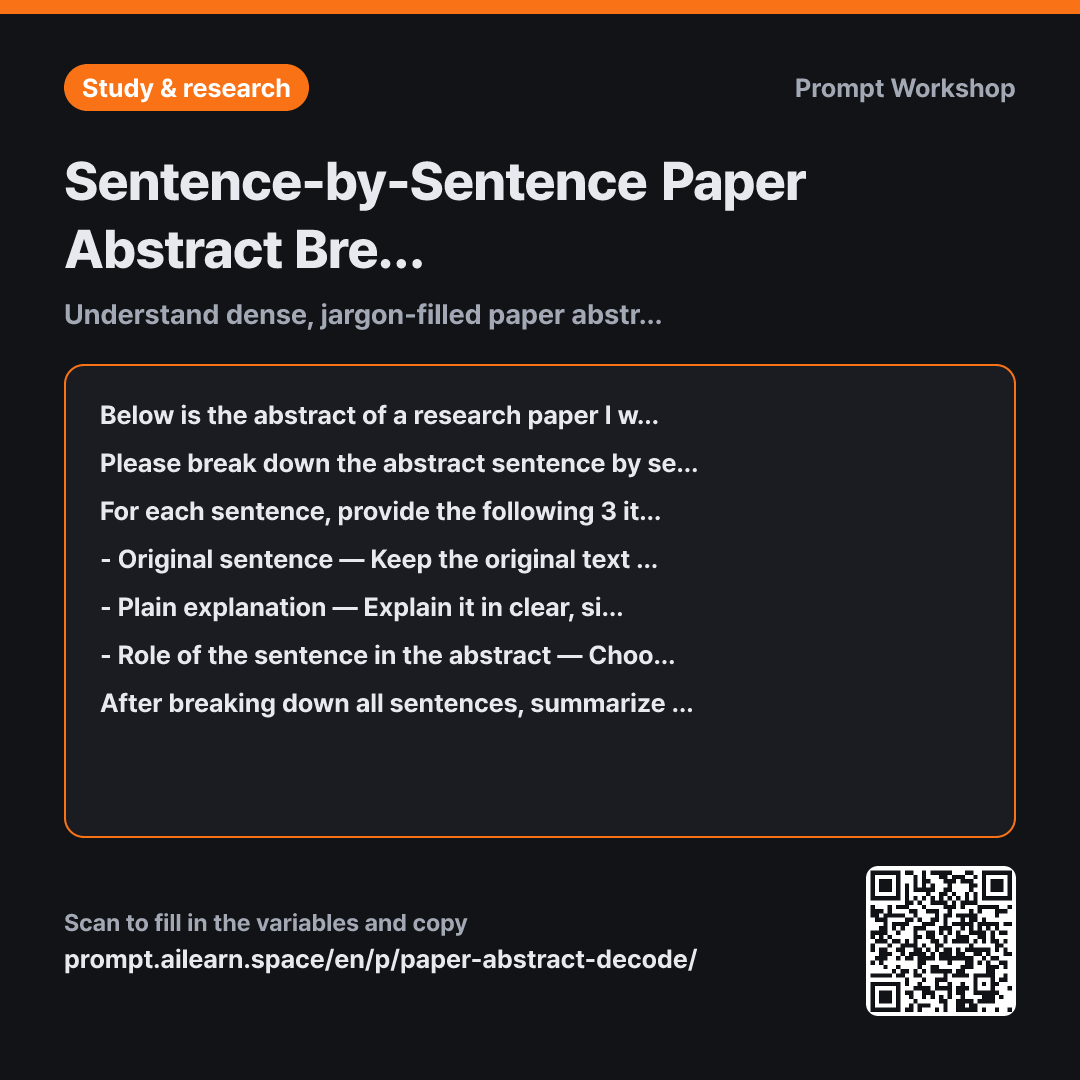
Translating or summarizing an entire abstract all at once produces smooth-sounding prose, but comprehension often remains blocked. A standard translation just swaps words without revealing what role each sentence actually serves. When analyzing a dense academic abstract, what you truly need to identify is whether a sentence represents background context, methodology, or a key finding. Because an abstract compresses background, problem, method, result, and limitations into just 5–6 sentences, identifying the functional role of each sentence instantly maps out the entire study's structure.
This is why the process is divided sentence by sentence. When asked to summarize everything at once, AI models tend to overemphasize findings while glossing over subtle methodological conditions. Forcing a step-by-step breakdown ensures that even minor conditional clauses get the analytical attention they deserve.
The format explicitly enforces three components: original sentence, plain explanation, and structural role. Keeping the original text alongside the breakdown is crucial. If any part of the interpretation feels uncertain, you can cross-check it immediately with the line above without needing to look up the original paper again when citing. Asking for "2 things requiring the full text" at the end prevents confusing the abstract with the complete study—crucial details like sampling procedures or long-term effect duration rarely appear in an abstract.
The initial instruction in the constraints section prevents the AI from blending its general field knowledge into the summary. While AI-generated background info often sounds plausible, it may not reflect the authors' actual claims and can lead to misattributing statements to the paper. The rule to preserve exact numbers serves the same purpose. Wrapping the abstract in """ delimiters ensures that embedded keyword lists or footnotes are not mistakenly executed as operational instructions.
Unfamiliar terms? See Aha AI: hallucination, chain-of-thought
Compared with a bad example
Translate this paper abstract for me.
(paste abstract)
This produces output that reads cleanly on the surface but fails to convey true structural understanding. Technical jargon is mapped to standard dictionary equivalents without contextual clarification, and it remains ambiguous which sentence reports the authors' original findings versus background literature. You end up having to re-read and decipher the paper from scratch anyway.
Variations
Deciding Whether to Read the Full Paper
Read the abstract below and extract only the factual criteria I need to decide whether this paper is worth reading in full.
Provide the following in order: 1) The research question answered by this paper (1 sentence) 2) The direct answer/finding (1 sentence) 3) The scope of applicability (target sample, duration, constraints) 4) 2 limitations or potential weak points apparent directly from the abstract Do not give recommendations like "You should read this"; provide only the objective criteria.
Abstract: """ {{paper abstract summary}} """
Useful for screening papers quickly during a literature review without doing a full-text deep dive. Explicitly blocks AI recommendations so the final judgment remains entirely up to the reader.
Clarifying Jargon and Core Concepts First
Identify all academic jargon, statistical terms, and domain-specific expressions from the abstract below that would trip up a reader without specialized background.
For each item, list: - Original term - Contextual meaning in this paper (1 line) - 1 foundational concept required to understand this term Ensure the glossary is clear enough to stand on its own without reading the abstract.
Abstract: """ {{paper abstract summary}} """
Useful when terminology creates a high barrier to entry before sentence-level comprehension is even possible. Reviewing this quick glossary first makes using the primary prompt significantly smoother.
Model notes
If the abstract contains heavy mathematical formulas or statistical symbols, add: "Leave all symbols intact and simply explain how to interpret them in plain terms."
Related prompts
Last updated 2026-09-02 · Found a mistake? Let us know