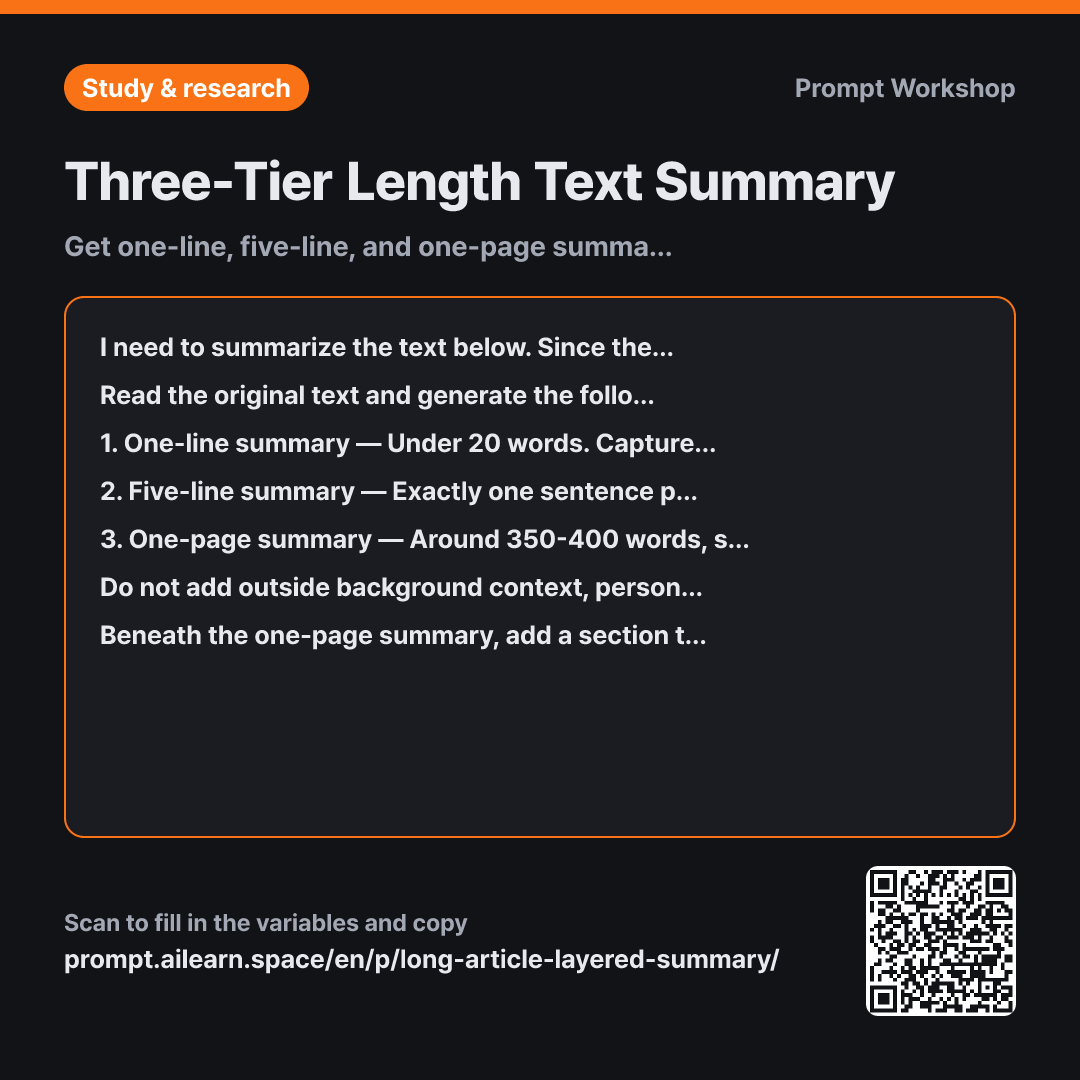
Why it is written this way
When you ask for a summary without specifying length, you almost always get an awkward middle-ground response—too long for a quick Slack message, yet too brief to use as evidence in a report. The biggest time sink with AI summarization is the back-and-forth cycle of "make it shorter" and "expand this part." Asking for three distinct lengths simultaneously eliminates that friction.
Format defines a unique role for each tier. The one-line version captures solely the core thesis, the five-line version introduces evidence and nuances, and the one-page version outlines the structured flow. When only word counts differ without distinct structural requirements, models often just stretch or shrink identical sentences. Assigning specific components to each length gives each tier a distinct practical utility.
Requiring that "summaries must not contradict each other" acts as a built-in verification check. A nuanced finding in a longer summary often gets flattened into an overgeneralized absolute statement in shorter formats; putting them side-by-side makes distortions immediately apparent.
Constraints prevent the summary from turning into an editorial commentary. AI models tend to inject outside domain knowledge or unprompted evaluations like "this represents a meaningful step forward," blurring the line between the source text and model interpretation. The final "Omitted Details" section helps you quickly determine whether the summary is self-sufficient or if you need to consult the original document. Wrapping the source text in """ ensures headers and quotes inside the text are not misinterpreted as prompt instructions.
Unfamiliar terms? See Aha AI: output-format, context-window
Compared with a bad example
Summarize this article
(paste long text)
This typically yields a generic 5–6 line paragraph. It is too bulky for a chat message and lacks enough detail for a formal document, forcing you into repeated rounds of "shorter" and "more detail." Each revision also shifts the focal point slightly, making it hard to track source fidelity.
Variations
Finding Common Themes Across Multiple Sources
Below are multiple source texts combined. Please generate a one-line summary for each individual text first, followed by 3 core claims common across all texts and 2 points of divergence or disagreement.
Add the source title or opening sentence in parentheses next to each point as supporting reference. Do not introduce any external conclusions not found in the texts.
Original text: """ {{original text}} """
When handling multiple source documents at once, structuring the output around shared themes and key differences is more actionable than producing simple separate summaries.
Converting to a Shareable Team Memo
Please turn the text below into an actionable memo for colleagues who have not read the original article.
Format the output in this order: - Line 1: "Why this matters to us" (1 sentence) - Lines 2–4: Core takeaways (3 bullet points) - Final Line: "Decisions required from our team" (1 sentence)
Do not invent internal company details absent from the text. If no clear decision point is implied in the text, leave the final line blank.
Original text: """ {{original text}} """
When the reader is clearly defined, the framing shifts from arbitrary word count to prioritizing what the recipient needs to do next.
Model notes
If the original text is exceptionally long, it is more reliable to request the one-line and five-line summaries first, then follow up with "Now expand item 3 in detail."
Related prompts
Last updated 2026-09-02 · Found a mistake? Let us know