Why it is written this way
When people try to create flashcards using AI for the first time, most run into the same issue: the back of the card turns into a dense paragraph. A card with a three-sentence back is just a summary sheet, not an effective active recall tool. This prompt fixes that issue up front by strictly capping the length and card count with concrete numbers.
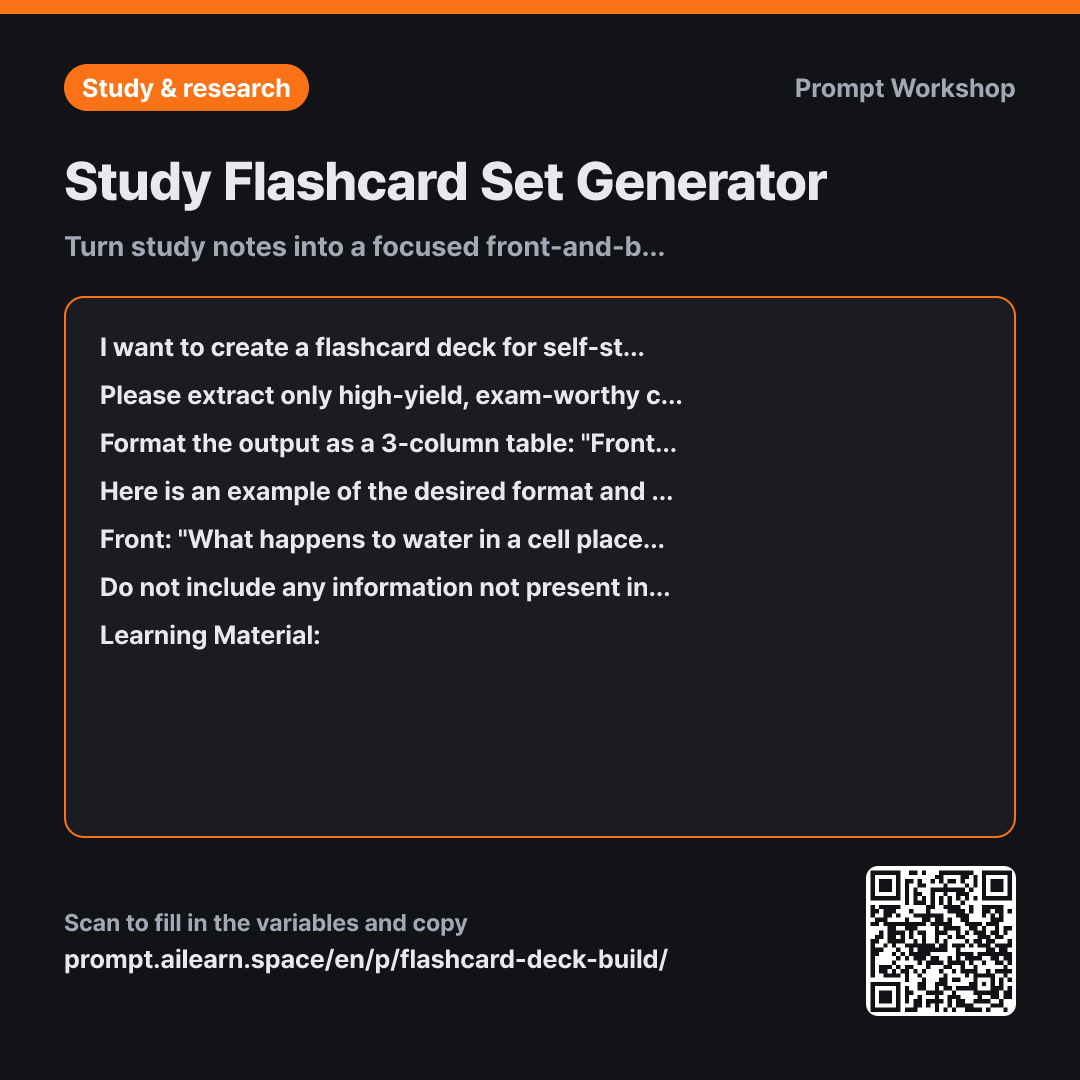
Format: Although concise, this section includes three strict constraints: a single question sentence on the front, under 15 words on the back, and a maximum of 20 cards. Without explicit length limits, AI tends to over-explain. The short character cap forces the model to extract single atomic facts instead of summarizing. The hint column gives a subtle stepping stone so you can trigger recall on your own rather than immediately flipping the card over.
Example: Providing a one-line example illustrates the exact structure without lengthy instructions. Merely saying "write as questions" often produces generic vocabulary headers like "What is osmosis?". The concrete example teaches the AI to provide a scenario-based trigger and a precise consequence.
Constraints: Banning vague expressions like "etc." ensures that every card is definitively self-gradable. If the back says "lysis, turgor, etc.", you can never be sure if your mental answer was complete. Requiring exact counts in the question (e.g., "Name 3 factors...") makes grading objective. Cards that cannot be clearly scored as right or wrong do not build true retention.
Unfamiliar terms? See Aha AI: few-shot, output-format
Compared with a bad example
Make flashcards from this text
(paste study notes)
Without setting card counts or length constraints, the AI will simply split entire paragraphs across front and back. Long card backs defeat active recall, and cards that pack multiple concepts make it impossible to identify which part of the answer you actually missed.
Variations
For Vocabulary & Terminology
Please create a flashcard deck from the following vocabulary list. Format as a 4-column table: "Front (Term) · Back (Single-line definition) · Example sentence · Easily confused term". Do not copy dictionary definitions; provide only the single most practical, high-frequency meaning. The example sentence must be under 12 words and rely crucially on the target term to make sense.
""" {{learning study material}} """
Memorizing isolated definitions often fails in real exams, so this variant adds an example sentence and a confusion-check column.
Fixing Hard-to-Memorize Existing Decks
Below is my existing flashcard deck. I want to troubleshoot the cards I keep missing after several days of review. For each card, check whether the front narrows down to a single unambiguous answer and whether the back can be self-graded in under 15 words. Provide a revised version side-by-side for problematic cards, and split any card containing multiple concepts into two separate cards.
""" {{learning study material}} """
Instead of generating from scratch, this diagnoses existing cards. Difficulty memorizing a card is usually a flaw in card design rather than memory.
Model notes
To export to Anki, append: "Instead of a table, output this as a comma-separated CSV with front, back, and hint fields."
Related prompts
Last updated 2026-09-02 · Found a mistake? Let us know