Why it is written this way
When people ask AI for memory tricks, they usually just get a single acronym or acrostic. The issue is that acronyms do not fit every list. When first letters form awkward combinations, the AI forces an unnatural sentence that becomes harder to memorize than the original list itself.
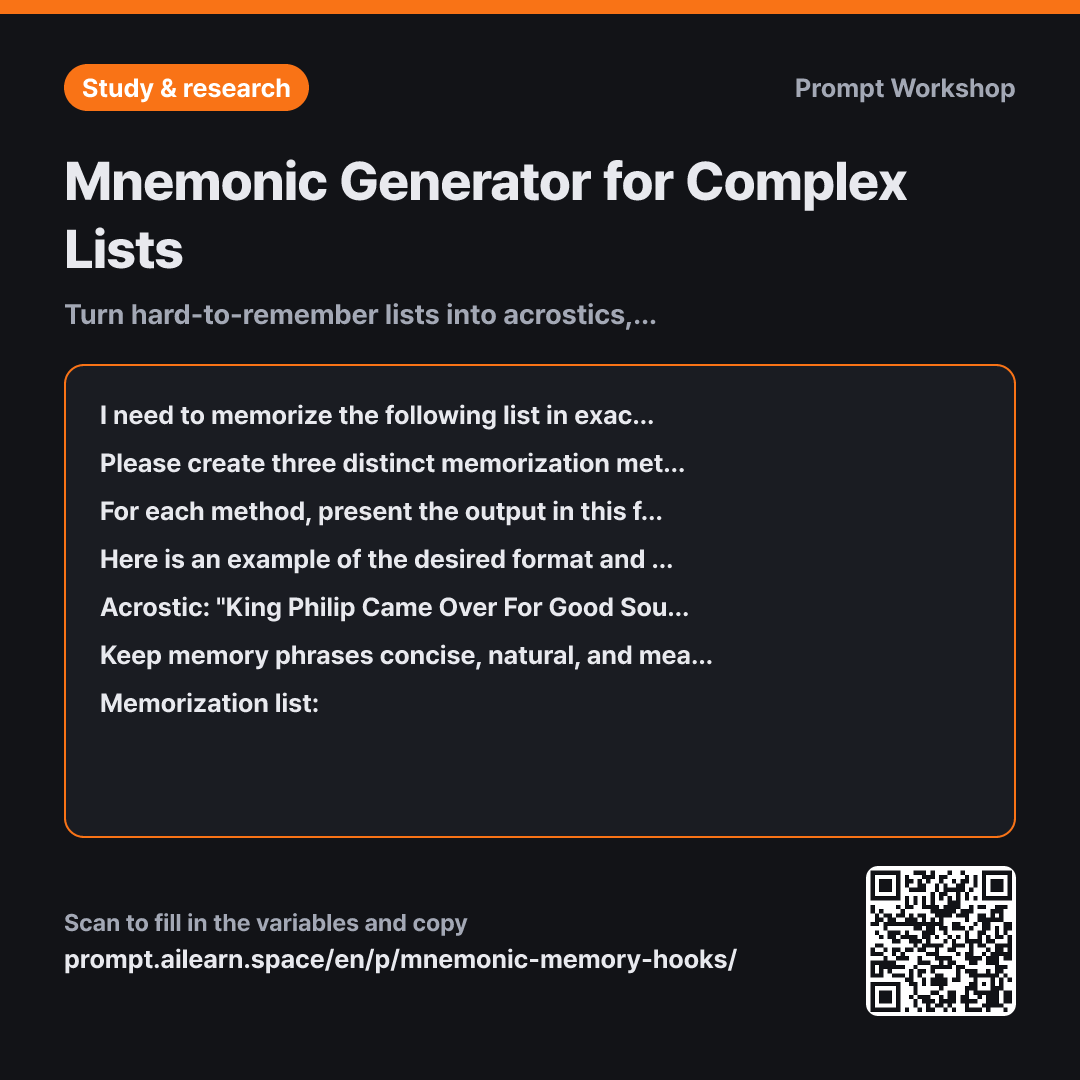
That is why the Task splits the solution into three methods. Acrostics, stories, and chunking all excel in different scenarios. Lists with fewer than five items work best with acrostics, while sequences of ten or more benefit from a chronological story. Heterogeneous items stick longest when grouped into conceptual chunks. Generating all three at once allows you to immediately pick the one that fits.
Adding an Example enforces the mapping table. Without an example, the AI often outputs just a standalone mnemonic phrase, leaving you unable to recall what each letter stood for a few days later. Showing the format directly ensures the generated memory aid is actually usable for long-term review.
Two lines in the Constraints are crucial: never skip items and never swap the order. Internalizing an incorrect sequence is far harder to fix than learning from scratch. Giving the model permission to decline an awkward technique prevents fabricated, nonsensical mnemonics and reveals the single best strategy for that specific dataset.
Compared with a bad example
Make a mnemonic to help me memorize this easily.
(Paste list)
Restricting the output to a single method forces awkward sentences for lists that do not fit the format. Without an explicit mapping table, you might remember the phrase but forget what the letters represent. Furthermore, omissions and order swaps easily slip through unnoticed.
Variations
Method of Loci (Memory Palace)
I need to memorize the following list in sequential order. Create a memory palace journey using a familiar everyday space (from the front door to the bedroom). For each location, specify: "Location · Visual Anchor · Corresponding List Item." Make the visual anchors vivid, exaggerated, and dynamic. Do not alter the order of items.
""" {{memorization list}} """
Ideal for lists where first letters do not easily form words. Exaggerated imagery ensures stronger visual recall.
Differentiating Two Confusing Concepts
I frequently confuse and swap the two concepts below. Identify the single decisive difference between them. Provide two distinct memory hooks tied directly to their names (e.g., spelling cues, phonetic associations, or etymological links), followed by a one-sentence check question I can use during an exam to verify the answer in under 30 seconds.
""" {{memorization list}} """
Designed for paired, easily confused terms rather than long sequential lists.
Related prompts
Last updated 2026-09-02 · Found a mistake? Let us know