Why it is written this way
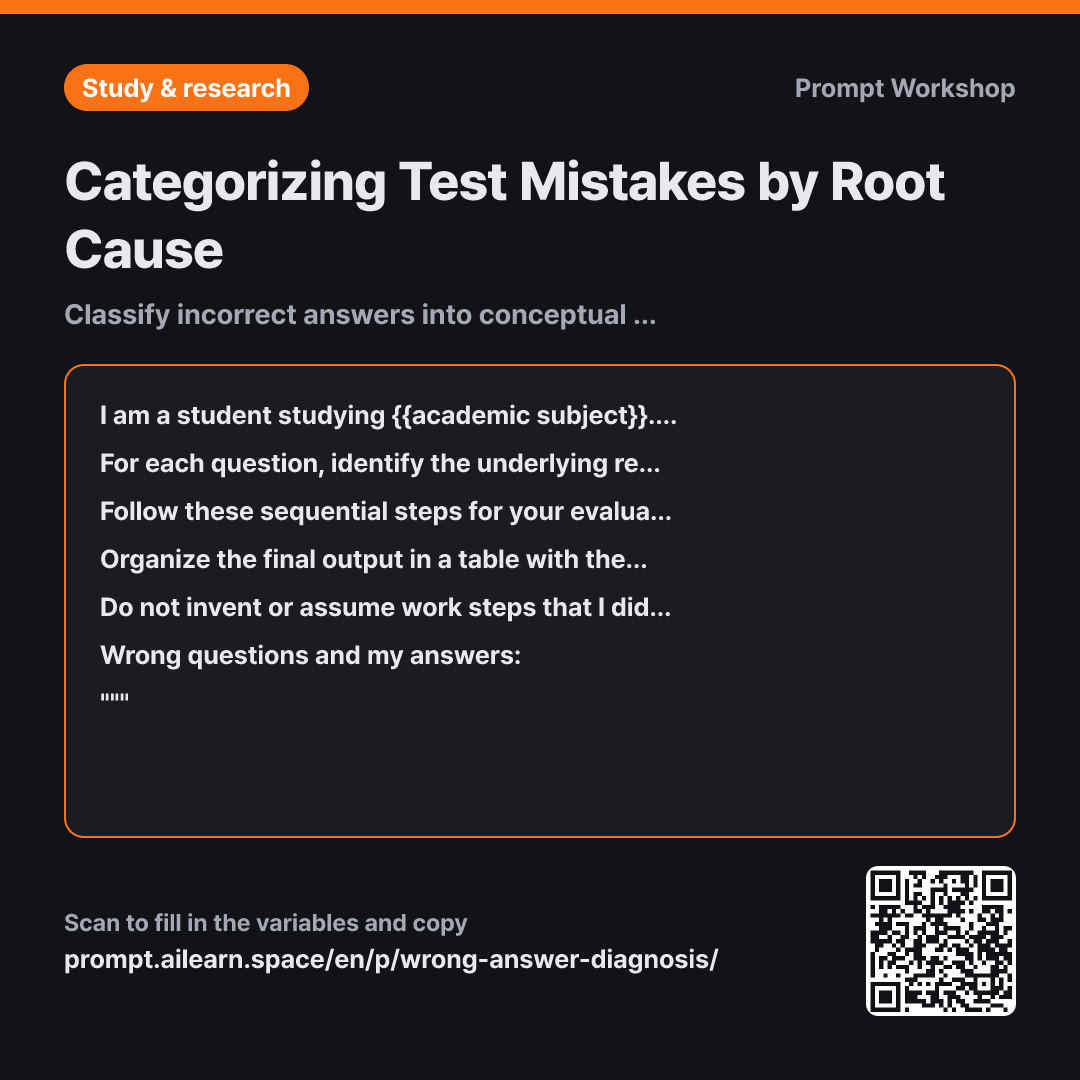
The most common mistake when reviewing incorrect answers is simply copying down the correct solution and moving on. An error log made that way gives you a false sense of understanding ("Oh, of course!"), only for you to repeat the exact same mistake on the next exam. What you need to record is not the answer key, but why you fell into that specific trap. Every paragraph in this prompt is designed to isolate that thinking process.
This is why the Task paragraph strictly confines the causes to four predefined categories. If you leave the categories open-ended, AI tends to default to vague phrases like "insufficient conceptual understanding" for nearly every error. When calculation slips and conceptual gaps get lumped together, your study strategy becomes ineffective. Providing an explicit "Undetermined" option prevents forced misclassifications. If you only provided a one-line answer with zero scratch work, it is natural that the cause cannot be pinpointed—and that serves as a reminder to show your work next time.
Breaking down the evaluation into three Steps forces the AI to reverse its default analysis order. Left unprompted, an AI immediately outputs the standard textbook solution, meaning your actual thought process never appears on screen. By demanding "Inferred Thought Process Behind My Answer" first, the focus shifts from copying answer keys to diagnosing cognitive patterns.
In the Format paragraph, the table structure is built to serve directly as an actionable error log. The summary tally below the table is especially useful: if six out of ten errors stem from calculation slips, you need better double-checking habits, not more theory lectures. Finally, wrapping the input in """ delimiters prevents the AI from mistaking problem text (like "Which of the following is true?") as system instructions directed at itself.
Unfamiliar terms? See Aha AI: chain-of-thought, output-format
Compared with a bad example
Tell me why I got these wrong.
(paste questions and answers)
Asking this way produces long textbook explanations for each problem. Since that information is already in your study guide, you gain little from reading it again. It completely fails to reveal whether multiple mistakes share a common root cause, leaving you to figure out what to prioritize on your own.
Variations
Prioritizing high-yield questions right before an exam
Below are the questions I got wrong in {{academic subject}} alongside my answers. My exam is in three days. Classify each question into one of three categories: "Must Re-solve / Memorize Answer Only / Skip/Drop", and provide a one-line rationale for each. Base your classification on the likelihood of the concept appearing again and the time required to master it. If more than five questions fall under "Must Re-solve", rank them in order of priority.
""" {{wrong question answer}} """
Replaces deep root-cause diagnosis with rapid triage and time management when the exam is imminent.
Reviewing free-response and essay questions
I am a student preparing for {{academic subject}}. Read the following free-response questions and my drafted responses, then point out where a grader would deduct points in the exact order of my sentences. For each deduction, tag the issue as "Missing Evidence / Incorrect Terminology / Logical Leap / Phrasing Issue", and provide a one-sentence example of how to rewrite that specific part. Do not rewrite my entire response from scratch.
""" {{wrong question answer}} """
Unlike multiple-choice items, free-response errors are distributed across individual sentences; this variant reviews errors sequentially within the student's own draft.
Related prompts
Last updated 2026-09-02 · Found a mistake? Let us know