Why it is written this way
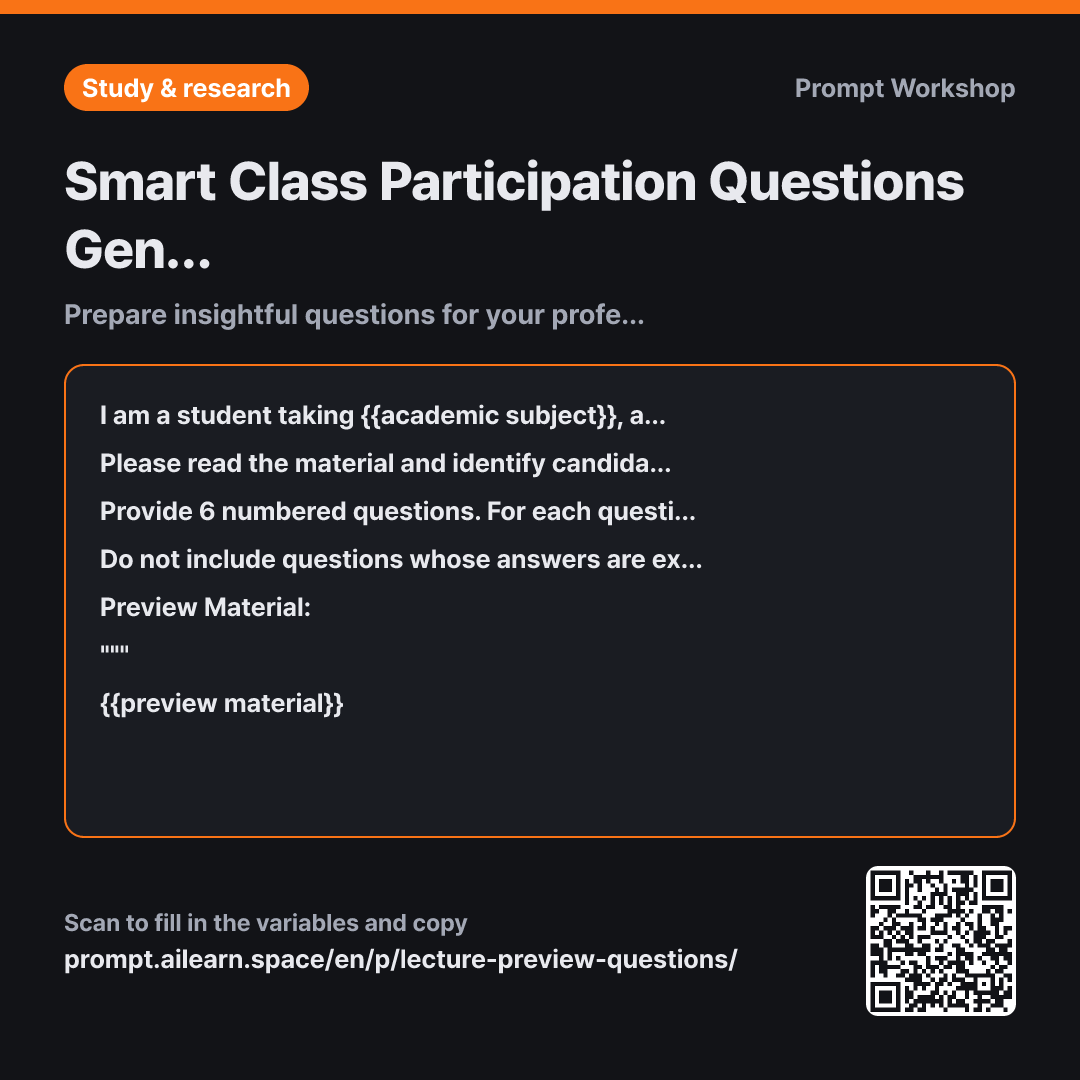
Prompts that simply ask for "questions from this text" usually generate obvious queries like "What is an indifference curve?" While structured as questions, the answers are right in the first sentence of the text—asking them in class only wastes time re-explaining what was already assigned. Insightful questions emerge from what the text left unsaid. This prompt instructs the AI to locate those specific gaps first.
The context in the first paragraph establishes two things: the academic subject and the realistic scenario of "raising a hand during lecture." Preparing a question for an in-class discussion requires a different focus than preparing a research paper. In-class questions must be concise enough to articulate in one sentence and focused enough for a professor to answer on the spot.
The second task paragraph guides the model on where to look rather than just what to ask. It targets skipped steps in logic, generalized qualifiers, and potential edge cases. When you ask an AI directly for questions, it often turns section headers into interrogative sentences. Directing it to look for logical friction points ensures the questions grow organically from the text.
The requirement to "quote the exact sentence verbatim" in the third format paragraph serves as a built-in verification mechanism. If the AI cannot quote a sentence, it means the question was hallucinated from outside knowledge, which tends to derail class flow. Finally, having the model pick the top two questions gives you an actionable priority list so you are ready to participate when the moment comes.
Unfamiliar terms? See Aha AI: context, output-format
Compared with a bad example
Here is my assigned reading for next class, please make 3 questions for me.
Chapter 3: Consumer Choice — The slope of the budget line represents the relative price...
This will yield basic textbook recall questions such as "What is the marginal rate of substitution?" or "Why is the budget line straight?" Asking these shows that you may not have understood the reading, wasting valuable class time. Without citing exact excerpts, there is no way to verify if the questions align with the lecture's pace, and you might end up with three redundant questions derived from the exact same paragraph.
Variations
When Preparing Questions for a Seminar or Presentation
Below is the material for an upcoming presentation in my {{academic subject}} course. Please generate 5 thoughtful questions to ask the presenter. The questions should aim to deepen collective understanding, not aggressively challenge them. For each question, provide: ① The question sentence ② A direct quote from the material supporting it ③ A likely response from the presenter along with 1 follow-up question to ask based on that response.
Presentation Material: """ {{preview material}} """
Preparing a follow-up question prevents the conversation from stalling after the first answer. In seminars and presentations, digging one layer deeper leaves a memorable impression.
When Identifying Your Own Comprehension Bottlenecks
Below is the preview reading for {{academic subject}}. Please identify 5 potential stumbling blocks where a first-time reader might get confused or stuck. Do not explain the concepts yet. For each point, provide a single-line explanation of why it is difficult and one self-check diagnostic question to test comprehension. Do not provide the answers yet.
Preview Material: """ {{preview material}} """
Use this when preparing before class to discover what you don't know you don't know. Withholding the answers forces active recall and genuine comprehension.
Related prompts
Last updated 2026-09-02 · Found a mistake? Let us know