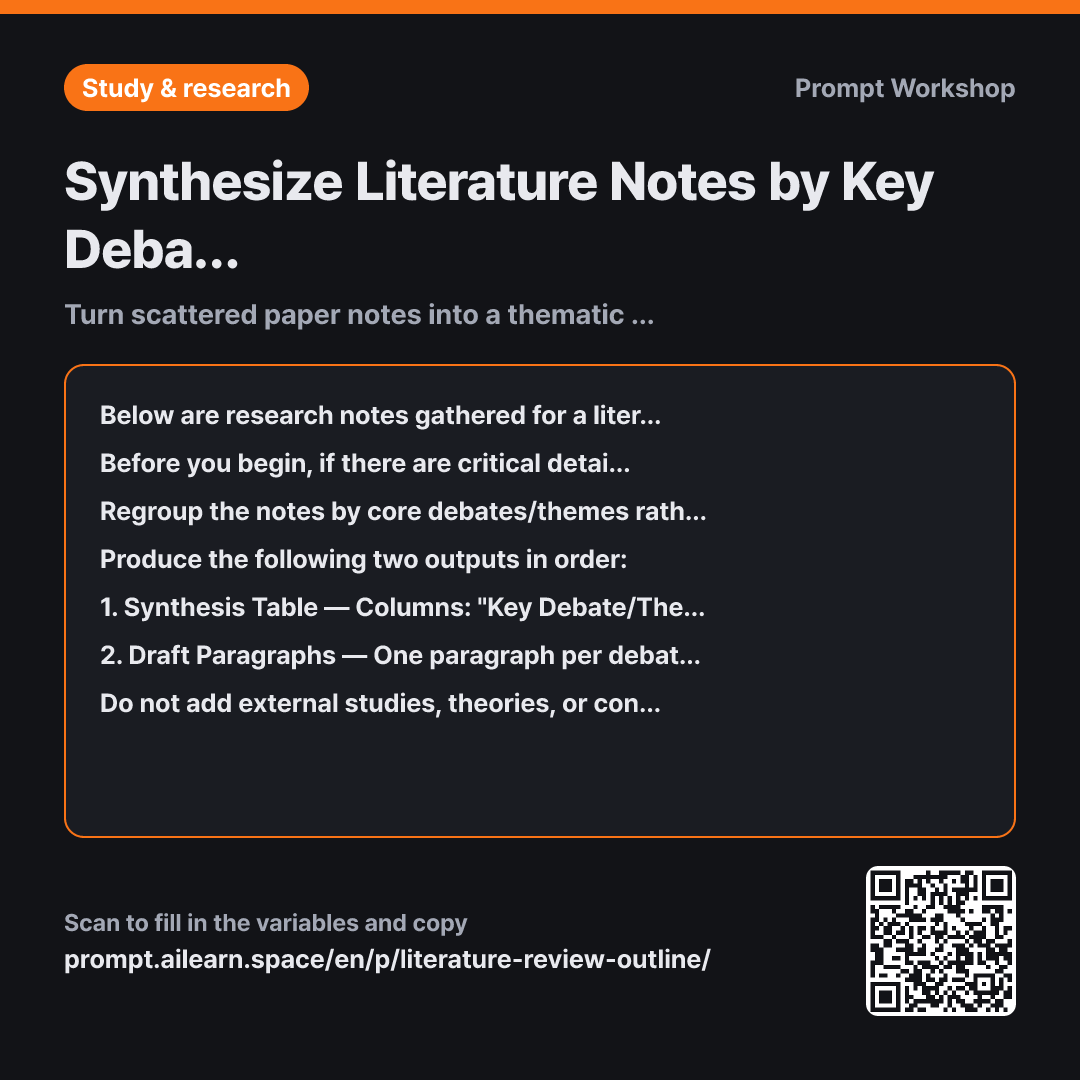
Synthesize Literature Notes by Key Debate Themes

Turn scattered paper notes into a thematic synthesis matrix and draft paragraphs.

Prompt · 2 variables

Below are research notes gathered for a literature review on "{{research topic}}". Right now, they are scattered as an unstructured list of individual papers.

Before you begin, if there are critical details missing from the notes that prevent you from synthesizing the debates, ask me up to 3 clarifying questions. If you have enough to proceed, start right away.

Regroup the notes by core debates/themes rather than paper by paper. Cluster together studies that address the same underlying question but yield different findings.

Produce the following two outputs in order: 1. Synthesis Table — Columns: "Key Debate/Theme · Supporting Studies · Conflicting/Mixed Studies · Unresolved Gaps" 2. Draft Paragraphs — One paragraph per debate theme, following the strict sequence: "Core Debate -> What key studies found -> Remaining Gap/Tension". Prioritize clear logical progression over polished prose, as I will rewrite the text myself.

Do not add external studies, theories, or conclusions not found in the notes. Use author names and years strictly as provided in the notes (or label as "Source Unknown" if missing). When studies conflict, do not judge which one is correct; only highlight what differences (e.g., sample size, duration, measurement tool) may have caused the discrepancy. If a note does not fit into any central theme, place it in an "Uncategorized Notes" section at the end rather than forcing it.

Paper Notes: """ {{paper notes}} """

Copy, then paste here · ChatGPT and Claude open with the prompt filled in Open in ChatGPT ↗Open in Claude ↗Open in Gemini ↗ Edit in builder Download classroom card

Some variables here may contain personal data. Replace real names, numbers and company names with placeholders.

Why it is written this way

Context
Below are research notes gathered for a literature review on "{{research topic}}". Right now, they are scattered as an unstructured list of individual papers.
Ask back
Before you begin, if there are critical details missing from the notes that prevent you from synthesizing the debates, ask me up to 3 clarifying questions. If you have enough to proceed, start right away.
Task
Regroup the notes by core debates/themes rather than paper by paper. Cluster together studies that address the same underlying question but yield different findings.
Format
Produce the following two outputs in order: 1. Synthesis Table — Columns: "Key Debate/Theme · Supporting Studies · Conflicting/Mixed Studies · Unresolved Gaps" 2. Draft Paragraphs — One paragraph per debate theme, following the strict sequence: "Core Debate -> What key studies found -> Remaining Gap/Tension". Prioritize clear logical progression over polished prose, as I will rewrite the text myself.
Constraints
Do not add external studies, theories, or conclusions not found in the notes. Use author names and years strictly as provided in the notes (or label as "Source Unknown" if missing). When studies conflict, do not judge which one is correct; only highlight what differences (e.g., sample size, duration, measurement tool) may have caused the discrepancy. If a note does not fit into any central theme, place it in an "Uncategorized Notes" section at the end rather than forcing it.
Input
Paper Notes: """ {{paper notes}} """

When asked to summarize literature, AI often defaults to sequential summaries: "Kim (2021) showed X. Lee (2019) showed Y." That produces an annotated bibliography, not a literature review. A literature review synthesizes how a field is divided and positions the gap where your own study belongs. The core purpose of this prompt is shifting the organizing axis from individual papers to overarching debate themes.

Allowing the model to clarify first in the second paragraph prevents premature assumptions. Notes often lack details like sample sizes or timeframes, and defining the right debate axes depends heavily on the researcher's specific focus. Limiting the model to a maximum of three questions ensures the workflow stays focused without descending into endless Q&A loops.

The format section sequences the table before the text. Generating the structural matrix first ensures the subsequent narrative paragraphs faithfully follow the structured evidence. The "Conflicting/Mixed Studies" column is crucial because where existing findings diverge is precisely where new research opportunities emerge.

The constraints prevent the AI from making editorial judgments on which study is "correct." When findings conflict, the review needs to identify methodological differences—such as study duration, sample scale, or measurement tools. Separating out an "Uncategorized Notes" section preserves thematic clarity without artificially forcing irrelevant studies into a debate. Wrapping the notes in """ delimiters prevents personal commentary within the notes from being misinterpreted as prompt instructions.

Unfamiliar terms? See Aha AI: context-window, hallucination

Compared with a bad example

Common bad example

Summarize my literature review notes.

(Paste paper notes here)

This outputs a passive, study-by-study summary. Even when studies directly contradict one another, their differences remain unanalyzed, typically ending with a vague cliché like "Various studies have been conducted." It fails to highlight research gaps, making it unusable as a draft.

Variations

When debate themes are not yet clear

When debate themes are not yet clear

Read the notes on "{{research topic}}" below and propose 3 to 5 candidate axes/themes for organizing these studies.

For each axis, provide a one-line explanation of "What this theme reveals" and list the study names that belong under it. Do not generate full tables or paragraphs yet.

Paper Notes: """ {{paper notes}} """

Use this variant when you are exploring multiple ways to structure your synthesis before committing to a final outline.

When searching for research gaps

When searching for research gaps

Below are literature notes on "{{research topic}}". Identify the unresolved research questions that remain across these studies.

List them in this order: unstudied populations/durations/conditions, unresolved contradictions between findings, and incomparability due to different measurement tools. Include the cited notes in parentheses for each point. Do not suggest specific research topics.

Paper Notes: """ {{paper notes}} """

Useful for framing problem statements. Recommendation of new topics is explicitly restricted to keep the focus grounded in actual evidence.

Model notes

If you have more than 20 papers, split them into batches of 10 to generate separate synthesis tables first, then ask the model: "Merge the themes from these two tables into a unified matrix."

Related prompts

Last updated 2026-09-02 · Found a mistake? Let us know