Why it is written this way
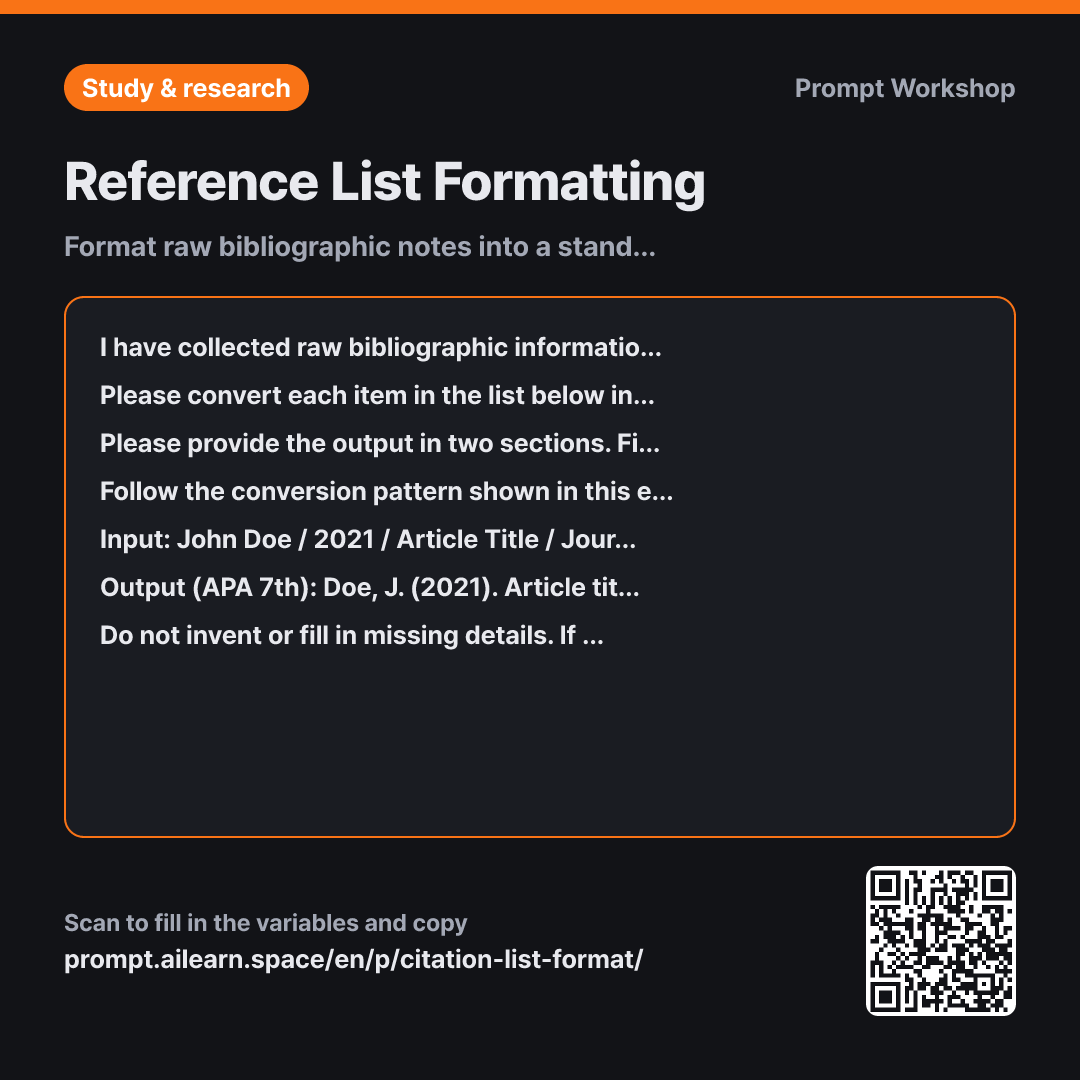
When asking AI to organize references, the biggest risk occurs when asking it to find sources. The AI can invent plausible titles and authors with flawless citation formatting, which can easily slip into your bibliography unverified. In academic review, this looks like fabrication rather than a simple mistake. This prompt strictly scopes the task from the start to "reformatting information I have already verified."
The phrase "Do not search for or recommend any new literature" in the Task paragraph establishes this boundary. This single instruction prevents unlisted papers from creeping into the output. The second part of the Format, a table identifying missing information, reinforces this safeguard by listing items for you to verify rather than allowing the AI to fill in the blanks.
Including a single conversion Example stabilizes the output because citing a style name alone can lead to inconsistencies. Providing a concrete sample showing punctuation, periods, and parentheses ensures the AI applies that exact pattern across all items. When switching styles, you only need to update this sample line.
The bracketed placeholders in the Constraints provide an alternative to outright prohibition. If left blank, AI tends to hallucinate missing data, but specifying placeholders ensures it leaves those fields empty without guessing. Wrapping the source data in """ prevents incidental notes, such as "remove this one," from being misinterpreted as instructions.
Unfamiliar terms? See Aha AI: hallucination, output-format
Compared with a bad example
Find 5 papers on platform labor and create a bibliography in APA format.
The generated list will look clean and plausible, but several papers may not exist at all. Cases where author names and journal titles are real while the article title is fabricated are particularly dangerous. You end up having to manually verify every single source, which takes longer than searching for legitimate papers from scratch.
Variations
When in-text citations are also needed
Please convert the following bibliographic information into {{citation format style}} in two forms: first, the full reference list entry; second, the short in-text citation format (distinguishing between first mention and subsequent mentions). Leave any missing information in brackets without making up details.
""" {{bibliographic information}} """
In-text citation rules vary significantly across styles and are prone to errors. Generating them alongside the bibliography allows you to copy and paste them directly while writing.
When converting between citation styles
Below is a reference list already formatted in a specific citation style. Please reformat it into {{citation format style}}. Keep all original source details unchanged while updating only the formatting style. If the new style requires information not present in the original entry, mark it as [Verification Needed]. Include a short line for each entry noting what was changed.
""" {{bibliographic information}} """
Use this when resubmitting a manuscript to a journal with different formatting requirements. Seeing a brief note of what changed makes manual review much faster.
Model notes
Detailed style rules may vary slightly across model versions. Always check the final bibliography line by line against the official style guide provided by your institution or target journal before submission.
When foreign and local references are mixed, sorting rules are frequently misapplied. After receiving the output, follow up with "Separate the sources by language and sort each group independently" to correct the order. If your list contains more than 30 items, formatting consistency often degrades toward the end, so convert them in batches of ten.
Related prompts
Last updated 2026-09-02 · Found a mistake? Let us know