Why it is written this way
If you prompt an AI generator without specifying camera parameters—using vague terms like "cinematic shot"—the model defaults to a generic, eye-level, medium-distance perspective every time. Even if you generate ten variations, the distance and angle will drift randomly, making it impossible to replicate a composition you liked. Camera terminology is what locks down the framing.
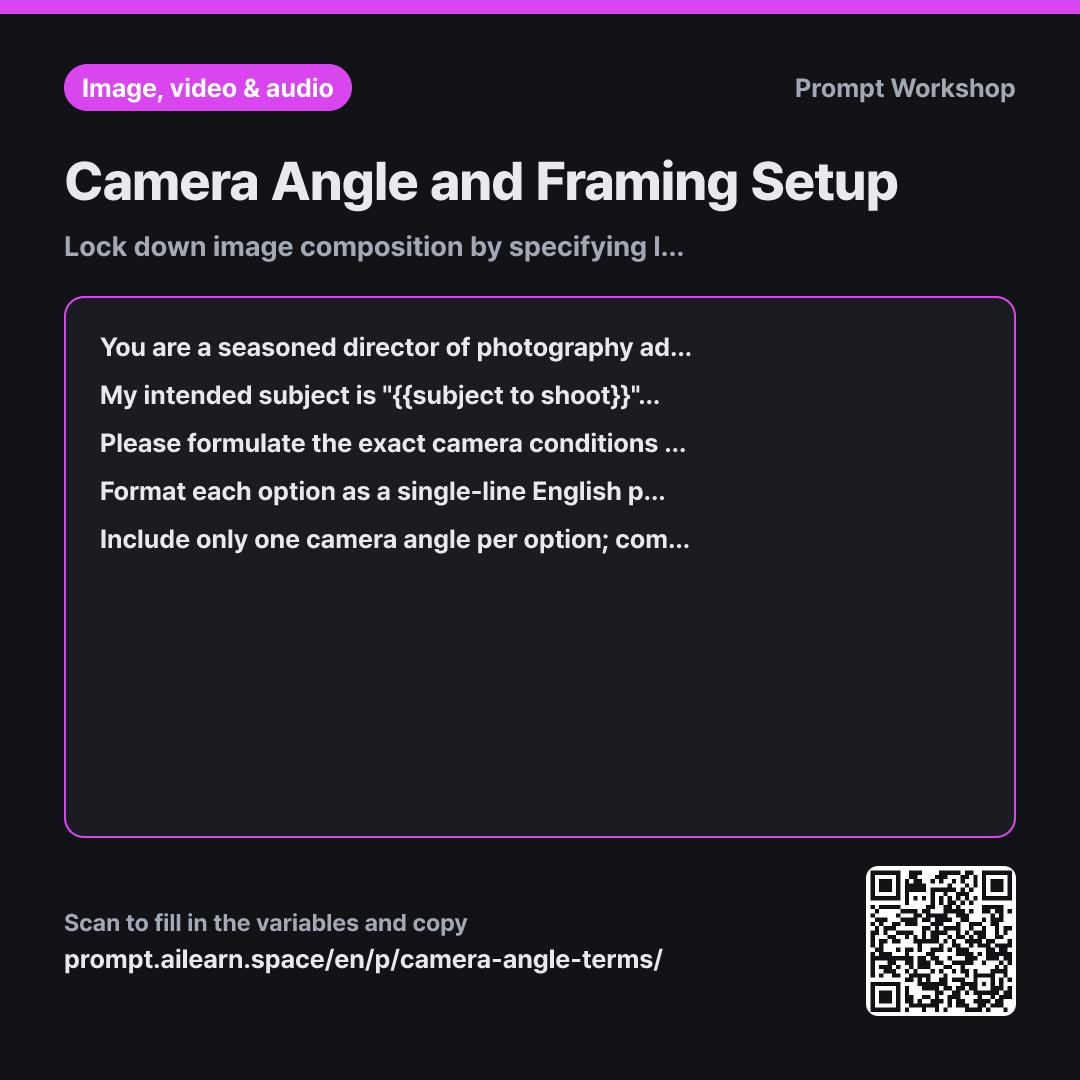
The Role prompt shapes the technical precision of the response. Instead of subjective suggestions like "shoot from above," the role of a director of photography forces the output to define concrete values: focal length, camera elevation, and spatial distance. These are terms the underlying models were directly trained on.
The Task section requires the model to define five distinct physical parameters: focal length, elevation, angle, distance, and depth of field. Prompt drift usually occurs when one of these five remains undefined. Notably, people often conflate camera distance with focal length; however, a wide-angle close-up produces a radically different background compression than a telephoto long shot.
The "Drawbacks" column in the Format section addresses a common pitfall: stacking too many dramatic keywords. An overly shallow depth of field obliterates important background context, while an extreme low-angle can distort the subject excessively. The Constraints section prevents conflicting instructions (like mixing high and low angles), ensuring the AI doesn't default to a flat composition.
Unfamiliar terms? See Aha AI: role-prompting, output-format
Compared with a bad example
Write an image prompt for a ceramic cup with a cool camera angle.
This will yield vague buzzwords like "dynamic composition, beautiful angle, professional shot." Since none of these tell the camera where to stand, the AI still produces a bland, eye-level, straight-on shot where the delicate surface texture gets lost. Running ten iterations will simply result in ten unpredictable framings.
Variations
Multi-Angle Product Shot Consistency
I want to create a cohesive set of product images featuring "{{subject to shoot}}" captured from multiple perspectives. Please provide 4 distinct, non-overlapping shot types (e.g., straight-on eye-level, three-quarters profile, top-down flat lay, and macro detail). Write a single-line English prompt for each shot, keeping the lighting, environment, and background descriptions strictly identical word-for-word across all four. Below each line, add a brief note explaining what specific product information that angle communicates.
Product listings require a consistent multi-angle set. Locking down the lighting and environment while only changing the camera framing ensures the item looks identical across all shots.
Subject Isolation with Background Separation
I want to isolate "{{subject to shoot}}" with crystal-clear focus while dropping the background into a clean, smooth blur, highlighting "{{desired visual impression}}". Please determine the exact English photographic terms for depth of field (aperture), subject distance, and background separation distance. Add a one-line warning pointing out which parts of the subject risk getting unintentionally blurred if the depth of field is set too shallow.
Aggressive background blur looks striking, but if overdone, it clips into the front or rear edges of the main subject. This prompt establishes safe optical boundaries.
Model notes
Photorealistic models follow lens and depth-of-field terms accurately, whereas illustrative and artistic styles may respond more weakly to camera mechanics. When using heavy stylized prompts, place camera terms near the beginning of the prompt string.
Related prompts
Last updated 2026-09-02 · Found a mistake? Let us know