Why it is written this way
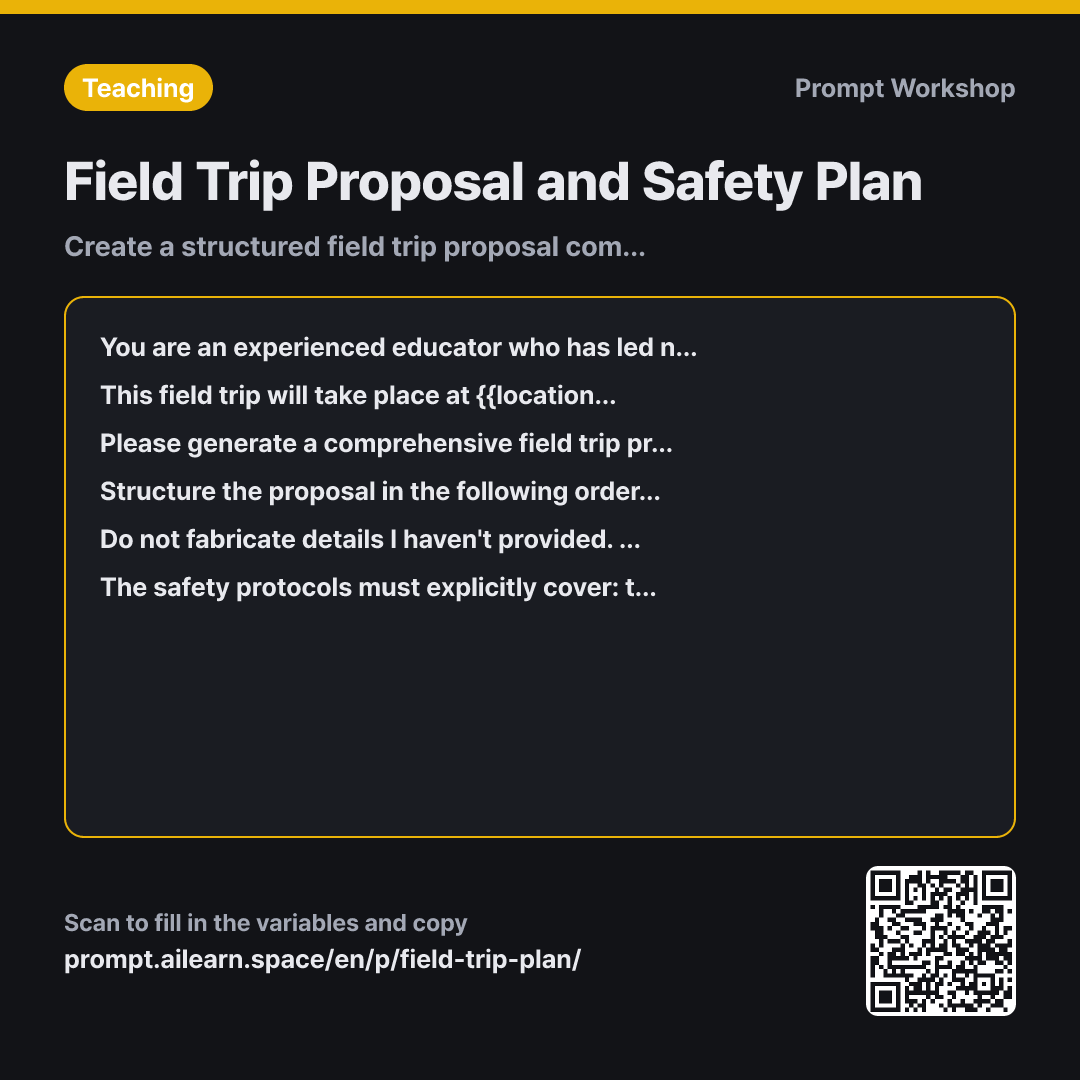
The biggest risk when asking AI to draft a field trip proposal is fabricated venue information. Models tend to guess opening hours, tour durations, and designated lunch areas with confidence. If those details are wrong, 80 students end up stranded on a bus. This prompt avoids that by explicitly demanding placeholders for unverified logistical details in the fifth paragraph. AI models often bypass negative constraints, but they reliably leave placeholders when given a designated format string.
Setting the Role in the opening paragraph to an educator who "always prioritizes safety over scheduling" shifts the weight of the output. Without this instruction, safety measures collapse into generic advice like "follow chaperone directions." With it, the AI details concrete decision-making criteria and responsibilities. Naming administrators and parents in the Context paragraph ensures the document strikes the right professional tone for formal approval and family communication.
Specifying the sequence and exact table columns under Format prevents common omissions. Without a "Decision Maker" column, critical calls like route changes get delayed during emergencies. Without an "Assigned Chaperone" column, transition periods between activities frequently end up under-supervised.
The Constraints in the final paragraph mandate five recurring safety scenarios (transit, separation, weather, health, emergency contacts). Conversely, placeholders are required for emergency facilities because hallucinated hospital names in a formal school document pose serious compliance and safety risks.
Unfamiliar terms? See Aha AI: role-prompting, hallucination
Compared with a bad example
Write a field trip plan for 5th graders visiting the science museum.
Generates a generic schedule with made-up departure and lunch times that bear no relation to the venue's actual operating hours. It invents specific exhibit names that might not exist and reduces safety protocols to a single sentence like "conduct safety orientation," omitting critical emergency procedures and missing-student protocols.
Variations
When you need a parent permission letter
Write a field trip permission letter and informational overview for parents regarding our trip to {{location}}. The participating group is {{grade and head count}}.
Keep it within a single page. Use clear subheadings in this order: Purpose · Itinerary Summary · Required Supplies & Packing List · Safety Protocols · Parent Requests. Leave unprovided details like exact dates, departure times, and fee collection amounts as "[School to confirm]". Include a return-slip section at the bottom for emergency contacts and medical/dietary disclosures.
Parent letters require a different tone, conciseness, and action-oriented phrasing compared to administrative proposals. The strict placeholder rule remains active.
When you need a post-trip evaluation template
Create a post-trip debrief and evaluation template for our completed field trip to {{location}}. The stated purpose was {{purpose}}.
Format this as a fill-in-the-blank guide with guided reflection questions. Organize it into four sections: Learning Objective Achievement · Schedule Deviations and Logistical Issues · Safety/Health Incidents or Near-Misses · Recommendations for Next Year. Provide 2–3 specific, easy-to-answer prompts under each section. Do not draft complete narrative answers on my behalf.
Letting AI generate the final evaluation creates fictional outcomes. Providing a structured questionnaire for teachers to fill out ensures accurate record-keeping.
Model notes
Venue operating hours, ticket prices, and booking rules may be outdated even if the model presents them confidently. Always verify all logistical details directly with the facility.
Related prompts
Last updated 2026-09-02 · Found a mistake? Let us know