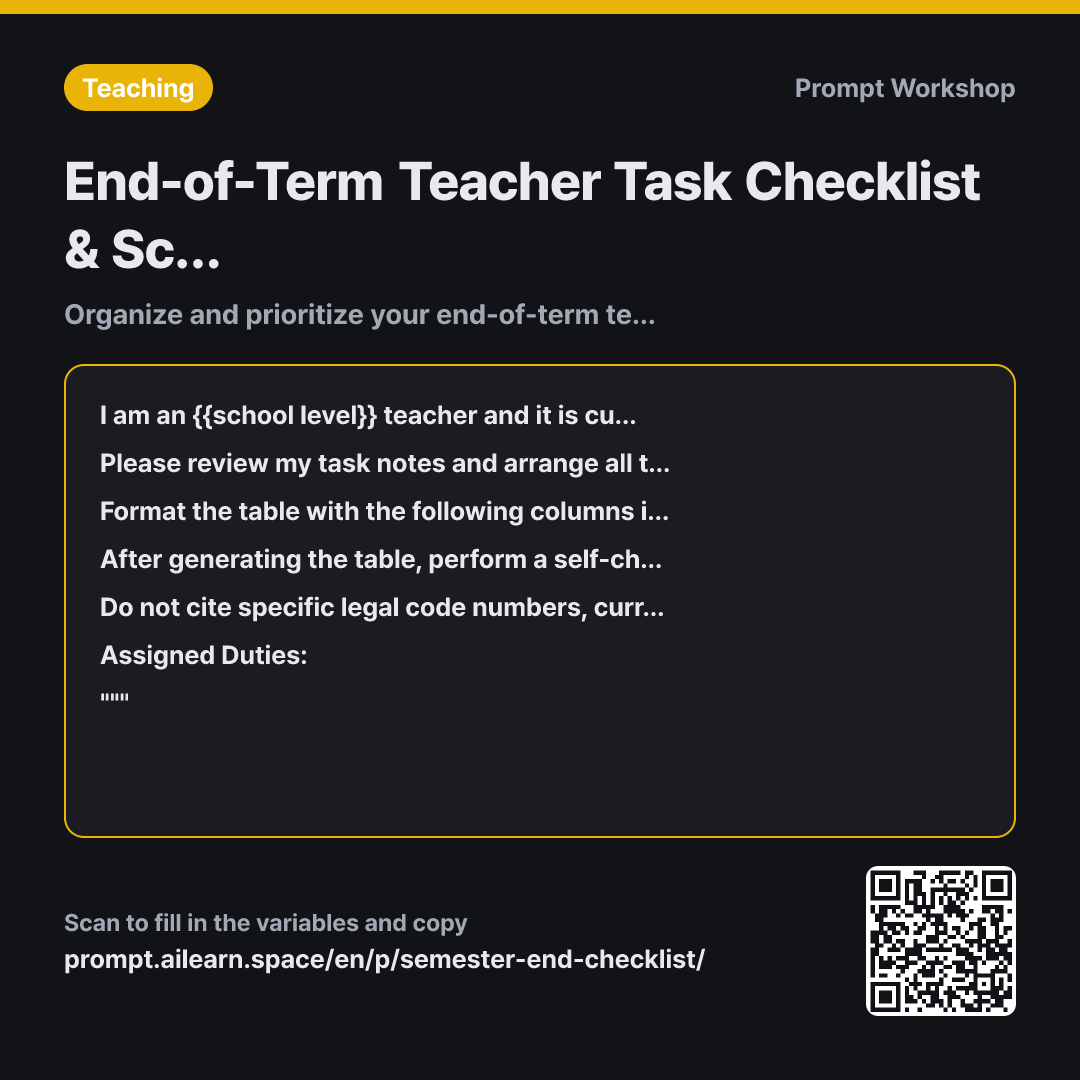
Why it is written this way
When listing end-of-term tasks purely from memory, something inevitably slips through the cracks. The omitted items are almost always the same: tasks without fixed deadlines that are easy to forget, such as returning inventory or preparing handover files for the next homeroom teacher. This prompt forces a two-step review to catch those blind spots.
The first paragraph sets the Context with your school level and known key dates. Elementary and secondary schools have noticeably different end-of-term responsibilities, and providing known deadlines prevents the AI from guessing arbitrary schedules. The second paragraph narrows the Task strictly to chronological ordering while providing an essential safety valve: routing generic or unlisted tasks into a separate "Potentially Missing Tasks" section. Without this restriction, AI tends to clutter your personal to-do list with generic school-wide duties.
In the Format, the "Prerequisites" column establishes clear dependencies. For instance, grades must be finalized before records can be written, which in turn precedes sending out report cards—a relationship often lost in simple date-based lists. "Can Do Alone" helps you spot items early that require coordination with other staff.
The fourth paragraph's Self-Check audits the final list across four distinct operational domains. While the first pass follows your rough notes, the domain-by-domain review catches systemic oversights. Finally, the negative constraints prevent hallucinations of non-existent policy codes or system menus, saving you from wasting time cross-checking fictional requirements.
Unfamiliar terms? See Aha AI: output-format, hallucination
Compared with a bad example
Help me organize what a teacher needs to do at the end of the semester.
(Pasted task notes)
This produces a generic, one-size-fits-all checklist. It mostly ignores your specific notes, mixes in duties you were never assigned (forcing you to delete them one by one), lacks concrete deadlines to establish priority, and overlooks partial progress notes like "half-completed conference notes."
Variations
When you only have one week left
I am an {{school level}} teacher. There are only 5 working days left until the end of the term. My known deadlines are {{deadline schedule}}.
From my notes below, select only the critical tasks that must be finished within these 5 days and distribute them by date. Assign no more than three items per day. For tasks that can be safely deferred to the vacation period, list them separately under "Can Be Postponed".
""" {{assigned duties}} """
Pulls strictly high-priority items instead of an exhaustive list. The "Can Be Postponed" section provides clarity on what has been intentionally set aside.
Creating a handover memo for the next teacher
I am an {{school level}} teacher. Below are the duties I handled this year. Please turn these into a handover transition memo for the next incoming teacher.
Organize it into a table with the columns: "Duty · Current Status · Immediate Next Steps for Successor · File/Material Location · Key Precautions". If I did not specify the location of materials, leave it as "[Confirm Location]". Keep all descriptions regarding students or parents strictly professional and non-identifiable.
""" {{assigned duties}} """
Reorganizes the same task notes into a transition document. The "Current Status" column ensures partially completed work is handed over accurately.
Related prompts
Last updated 2026-09-02 · Found a mistake? Let us know