Why it is written this way
When teachers rush to write a classroom management plan at the start of the year, they often end up with standard administrative jargon while missing crucial first-week logistics. Seating charts, classroom jobs, and planner routines get improvised within the first three days and stick for the rest of the year without any structured thought. This prompt fronts those critical operational decisions.
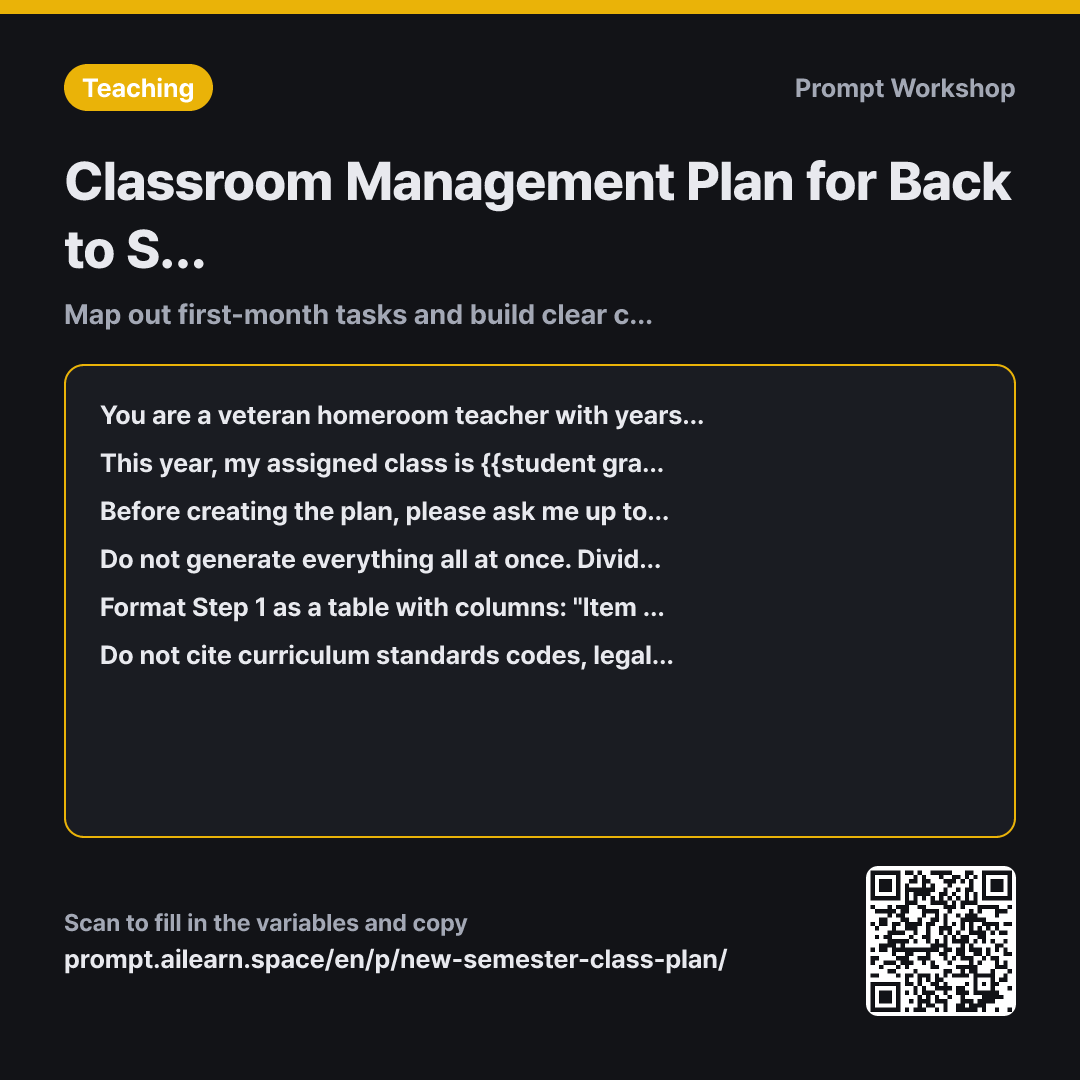
The role defined in the first paragraph ("knows what needs to be locked in first") prevents generic mission statements and forces immediate, actionable decisions to the top.
Splitting the task across three steps in the fourth paragraph prevents the model from compressing outputs. Generating everything at once causes the AI to truncate the end, leaving classroom rules as a 3-bullet afterthought. Step-by-step pacing ensures that choices made in Step 1 carry directly into the weekly timeline (Step 2) and classroom rules (Step 3). The up-front clarifying questions in paragraph 3 capture unique campus contexts that teachers often forget to mention.
Specifying the exact table format guarantees critical columns like "Student Involvement" and restorative consequences are not overlooked. The final paragraph enforces constraints against AI hallucinations, preventing fabricated state standard codes or school calendars.
Unfamiliar terms? See Aha AI: role-prompting, output-format
Compared with a bad example
Write a classroom management plan for 4th grade.
This produces a generic outline with broad headings like educational philosophy, character goals, and disciplinary procedures. It contains nothing immediately usable for Day 1 routines, and rules will be vague clichés like "Use kind words." It may also hallucinate curriculum codes or specific district regulations that require tedious manual fact-checking.
Variations
First-Week Classroom Schedule Only
I am a homeroom teacher for {{student grade level}}. My class has {{class size and dynamics}}. Please create a detailed schedule covering only homeroom/advisory time for the first 5 days of school.
Format this as a table with columns: "Day | Homeroom Activity | Materials Needed | Estimated Time". Include name-learning activities and seating arrangements on Day 1. Use "[Check School Calendar]" for school-wide assemblies or testing dates.
A condensed version for when time is short before the first day. It omits the multi-step questioning process and focuses solely on Day 1-5 homeroom periods.
Student-Led Classroom Rules Workshop
I want to establish classroom rules collaboratively with my {{student grade level}} students during a class meeting. Our primary focus this year is {{focus area}}.
Instead of writing the rules for me, provide a 40-minute facilitation lesson plan that guides students to create their own rules. Format it as a table with columns: "Time | Teacher Script/Prompt | Student Activity", including clear, student-friendly guiding questions. Below the table, list three real-life scenario prompts to use if students get stuck during discussion.
Focuses on co-creating rules with students to foster ownership, giving the teacher a ready-to-use facilitation script and discussion prompts.
Model notes
Executing all three steps in a single conversation thread is essential so that the decisions established in Step 1 flow naturally into the rules created in Step 3.
When executing multi-step generations in extended conversations, the AI may occasionally lose track of items defined in earlier steps. Before moving to Step 3, submit a brief confirmation like: "Please summarize the core routines from Step 1 before drafting the rules."
Related prompts
Last updated 2026-09-02 · Found a mistake? Let us know