Lyrics & Style Prompt for AI Music

Generate structured lyrics with metatags and an AI music style prompt.

Prompt · 3 variables

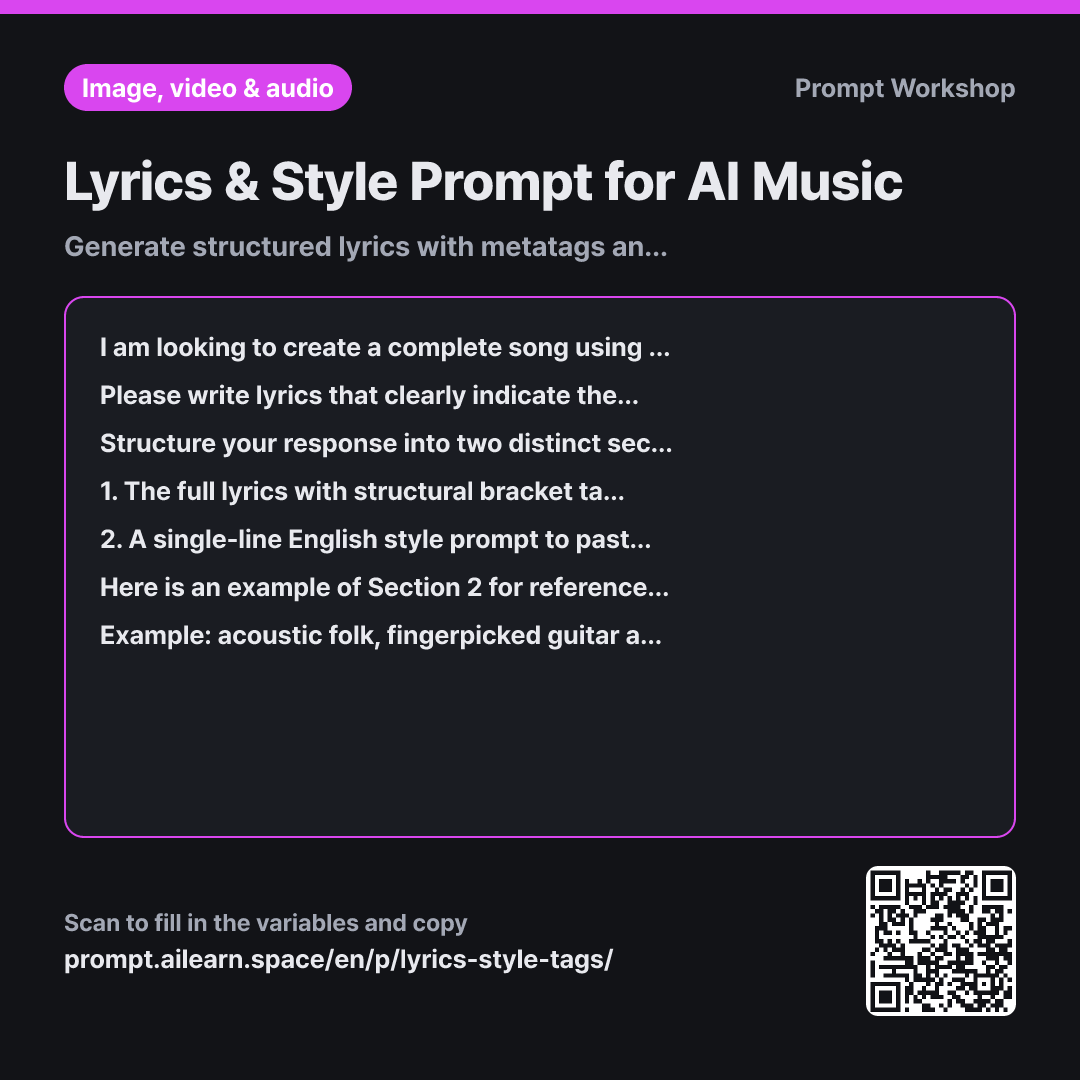
I am looking to create a complete song using an AI music generator (such as Suno or Udio). The song theme is "{{song theme}}", the genre is {{category genre type}}, and the target mood is {{overall atmosphere}}.

Please write lyrics that clearly indicate the song's structure rather than plain text. Use bracketed metatags before each section—such as [Intro], [Verse 1], [Chorus], [Verse 2], [Chorus], and [Outro]—and ensure the chorus repeats identically.

Structure your response into two distinct sections: 1. The full lyrics with structural bracket tags. 2. A single-line English style prompt to paste directly into the AI tool's style/prompt box. This line must list genre, core instruments, tempo/BPM, vocal profile (gender/register/tone), and overall mood, separated by commas.

Here is an example of Section 2 for reference (follow its structure and conciseness, not the specific content): Example: acoustic folk, fingerpicked guitar and light brush drums, 84 bpm, soft female vocal in a low register, warm and unhurried with a hopeful last chorus

Do not include real artist/band names or phrases like "in the style of" or "sounds like". Do not invent specific personal backstories, place names, or character names unless I provided them. Keep each lyrical line short enough to sing in a single breath, using natural, melodious phrasing.

Copy, then paste here · ChatGPT and Claude open with the prompt filled in Open in ChatGPT ↗Open in Claude ↗Open in Gemini ↗ Edit in builder Download classroom card

Why it is written this way

Context
I am looking to create a complete song using an AI music generator (such as Suno or Udio). The song theme is "{{song theme}}", the genre is {{category genre type}}, and the target mood is {{overall atmosphere}}.
Task
Please write lyrics that clearly indicate the song's structure rather than plain text. Use bracketed metatags before each section—such as [Intro], [Verse 1], [Chorus], [Verse 2], [Chorus], and [Outro]—and ensure the chorus repeats identically.
Format
Structure your response into two distinct sections: 1. The full lyrics with structural bracket tags. 2. A single-line English style prompt to paste directly into the AI tool's style/prompt box. This line must list genre, core instruments, tempo/BPM, vocal profile (gender/register/tone), and overall mood, separated by commas.
Example
Here is an example of Section 2 for reference (follow its structure and conciseness, not the specific content): Example: acoustic folk, fingerpicked guitar and light brush drums, 84 bpm, soft female vocal in a low register, warm and unhurried with a hopeful last chorus
Constraints
Do not include real artist/band names or phrases like "in the style of" or "sounds like". Do not invent specific personal backstories, place names, or character names unless I provided them. Keep each lyrical line short enough to sing in a single breath, using natural, melodious phrasing.

The most common mistake with tools like Suno or Udio is pasting unstructured lyrics as a single block of text. Without structural tags, the AI chops lines randomly, often swallowing the intended chorus into a verse and resulting in a flat 3-minute track with no dynamic build.

The Task section enforces bracketed tags ([Verse], [Chorus], etc.) to act as a clear roadmap for the generator. Requiring the chorus to repeat creates the memorable hook essential to song structure.

The Format requirement splits the output into two blocks because AI music generators use separate input fields for lyrics and style tags. Combining them leads to accidental lyric-bleeding where style instructions get sung out loud.

Providing an Example for the style prompt ensures the model outputs the correct tag sequence (genre, instrumentation, BPM, vocal type, mood) without over-explaining. Finally, the Constraint section prevents artist name drops, which trigger copyright guardrails and cause generation failures.

Unfamiliar terms? See Aha AI: output-format, few-shot

Compared with a bad example

Common bad example

Write lyrics for a song about sitting in an empty classroom after graduation. Make it a calm ballad.

The output lacks structural markers ([Verse], [Chorus]), causing the AI generator to treat it as one continuous verse without dynamic progression. A generic descriptor like "calm ballad" also fails to specify tempo, vocal timbre, or instrumentation, leading to inconsistent and unpredictable results across generations.

Variations

Structuring Existing Lyrics

Structuring Existing Lyrics

I already have drafted lyrics. Without altering the words, identify the song structure and insert bracketed tags ([Intro], [Verse 1], [Chorus], [Verse 2], [Bridge], [Outro]) before each section. If there is no distinct chorus, highlight the best lines to use as a recurring chorus and explain why. Below the tagged lyrics, provide a single-line style prompt suited for {{category genre type}}.

Use this when you want to preserve your original wording while adding the structural tags and style descriptors required by AI music engines.

Comparing Chorus Options

Comparing Chorus Options

Write 3 distinct chorus options (2 to 4 lines each) for a {{category genre type}} song about "{{song theme}}". - Option 1: Intimate and understated - Option 2: High-energy and climactic - Option 3: Ending on an open question

Below each option, add a one-sentence note explaining how well it delivers an {{overall atmosphere}} mood.

The chorus defines the core identity of a track. Locking down the hook first makes writing the surrounding verses much easier.

Model notes

Different tools parse metatags differently. Replace the words inside the brackets with your platform's supported tags before generating.

Different AI music platforms recognize slightly different meta-tags (e.g., [Hook] vs [Chorus], [Drop] for EDM). Check your specific tool's documentation and adjust the bracketed words if necessary. If you hit character limits in the lyrics box, trimming a secondary verse is better than cutting the chorus.

Related prompts

Last updated 2026-09-02 · Found a mistake? Let us know