Why it is written this way
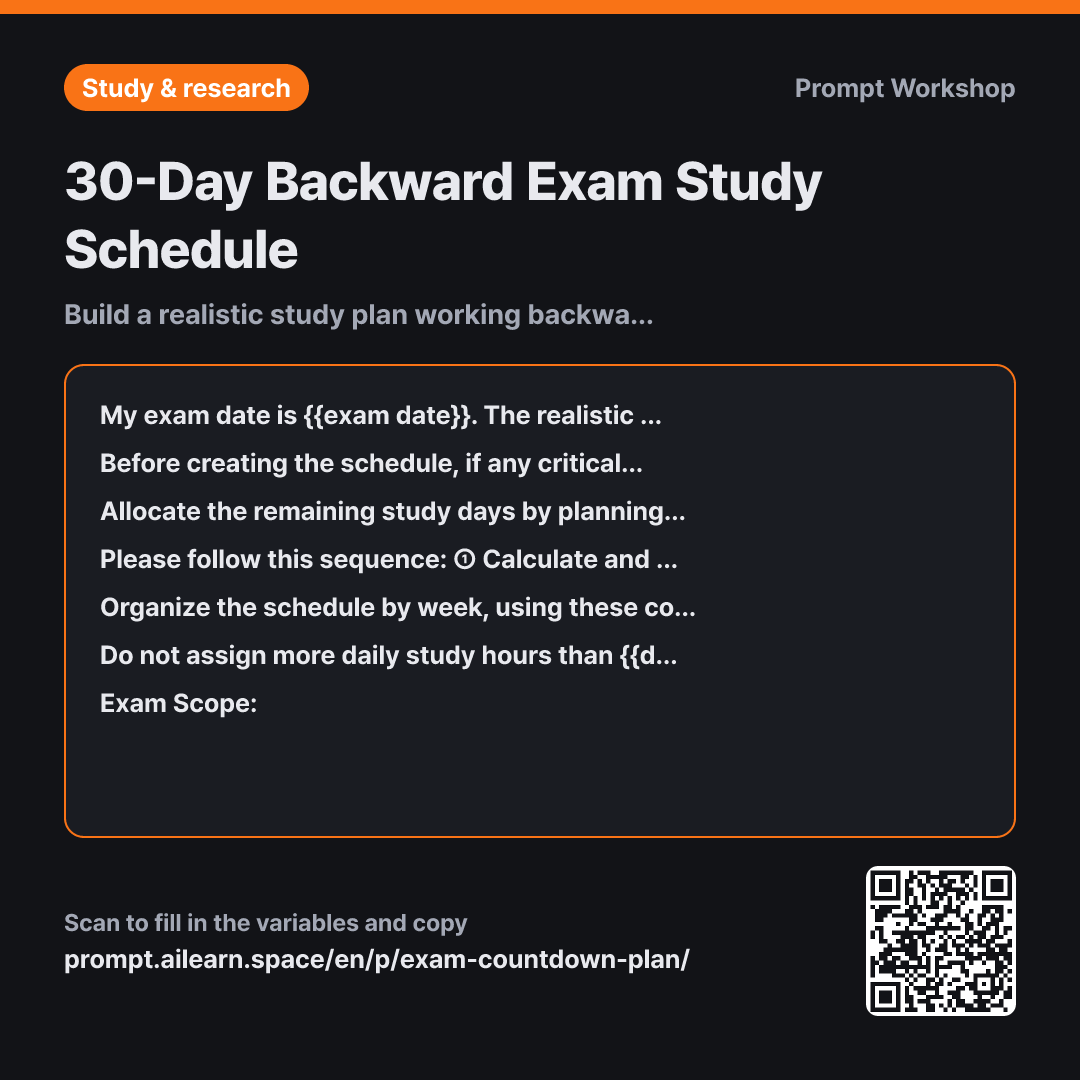
Planning a 30-day exam schedule forward from Day 1 leaves zero time for review in the final week. When you start from the beginning, new material gets pushed all the way to the day before the test. If you fall behind by just a day or two, the entire final week falls apart. This prompt builds the schedule backward from the finish line.
The step sequence in the fourth paragraph is the core. It forces the AI to calculate the total hours first, secure the final 3 days and the preceding week for revision, and only then distribute new material into the remaining days. Without this strict order, AI models will naturally fill from Day 1 just like humans. Step ⑤ provides an exit strategy: if the scope doesn't fit, it halts and asks what to cut rather than overloading the schedule.
The task in the third paragraph is focused into a single directive: "plan backward and allocate." The clarifying questions in the second paragraph surface hidden constraints that usually ruin plans, such as fixed blackout dates or topics already abandoned. Requiring the AI to pause and wait prevents it from generating questions and the full table at the same time.
In the format, the "D-Day" countdown column helps track progress far better than standard calendar dates. The "Review Plan" column indicates when freshly covered concepts will resurface for spaced repetition. The final constraints lock in hard daily time caps and dedicated catch-up days so the schedule remains sustainable.
Unfamiliar terms? See Aha AI: chain-of-thought, output-format
Compared with a bad example
I have an exam next month. Make me a study plan.
(pasting exam scope)
This results in a generic table evenly dividing progress across 4 weeks. Without knowing your available hours, it might assign 4 hours every single weekday, with review reduced to a simple "Week 4: Final Review" box. If you miss a single day, the entire schedule breaks with no buffer room, causing you to abandon the plan within days.
Variations
When Only One Week Remains
My exam date is {{exam date}}. There is very little time left, and covering the entire scope is impossible. My daily study time is {{daily study time}}.
First, organize the scope below into three categories: ① High-yield topics that directly produce points ② Time-consuming topics ③ Topics to drop for this exam. Then, fill the remaining days using only ① and ②, reserving the final day strictly for a high-level scan. Explicitly list below the table what was eliminated.
""" {{exam scope}} """
Forces the user to abandon covering everything from the start. Clearly seeing what has been dropped prevents panic during the actual exam.
Resetting Plan After Falling Behind
My exam date is {{exam date}}, and I have only completed about half of my original schedule so far. My daily study time is {{daily study time}}.
Please rebuild the schedule without merely piling overdue tasks onto the remaining days. First, ask me to separate the scope below into what I have not touched yet vs. what I have reviewed at least once. Once I answer, reallocate the remaining days based on my response. Do not increase the daily workload beyond what was originally set; instead, reduce the frequency of repeat reviews.
""" {{exam scope}} """
Increasing daily study volume after falling behind only leads to further delays. The solution is not adding daily hours, but cutting non-essential tasks.
Model notes
AI models frequently make calculation errors when counting remaining days. Cross-check the dates and countdown numbers in step ① with your actual calendar. If they are misaligned, prompt: "Re-read today's date and the exam date, and recalculate the exact number of days remaining."
Related prompts
Last updated 2026-09-02 · Found a mistake? Let us know