Why it is written this way
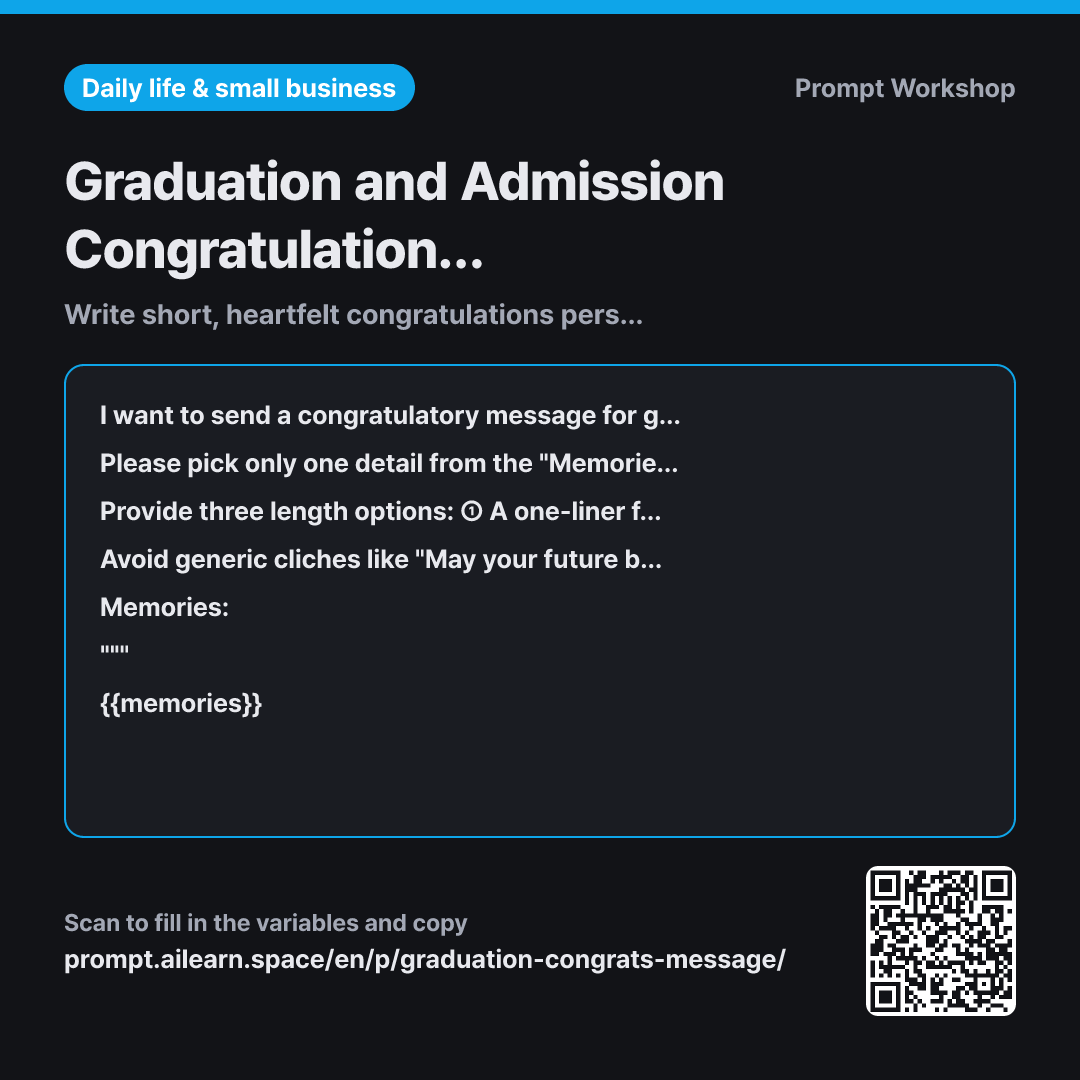
The most common ending for graduation messages is "Wishing you the best in your future endeavors." The moment a note ends like that, it feels like a generic template that could be sent to anyone, destined to be skimmed and tossed into a drawer. Instead of generating flashy rhetoric, this prompt ensures the message includes a specific touch unique to the recipient.
The context in the first paragraph establishes the relationship and setting. Tone and social distance differ greatly when writing to a nephew versus a student. By clarifying that the recipient is receiving many similar notes, AI focuses on finding unique details rather than just padding length. In the task section, restricting it to "pick only one detail" prevents the note from turning into a lengthy retrospective essay.
Requesting three lengths simultaneously caters to different use cases—a quick gift card vs. a text message—and choosing among options is much faster than editing down. The constraints block cliches and hallucinations. Making assumptions about future plans can put the recipient in an awkward spot, especially if things are undecided. Unsolicited advice is excluded for the same reason, as well-intentioned lectures often sound like nagging during celebrations.
The final line sets up iterative polishing. Asking for one adjustment at a time (e.g., "make it shorter") keeps the rest of the good phrasing intact without unsettling the entire output.
Unfamiliar terms? See Aha AI: hallucination, prompt
Compared with a bad example
Write a graduation message for my nephew
Knowing only the relationship, the AI gathers generic graduation tropes: "new beginnings," "limitless potential," and "bright future." It produces a template virtually indistinguishable from search engine snippets, often tacking on unsolicited advice like "study hard in high school."
Variations
When a Teacher Writes to the Entire Class
I am a homeroom teacher writing graduation notes for all students in my class, including {{recipient}}. Please pick only the common elements from the notes below and create a 2-line template to place after each student's name. Do not mention specific grades or incidents, and leave a placeholder formatted as [Insert one unique line about the student here] for me to fill in customized details.
""" {{memories}} """
Writing thirty entirely unique letters from scratch is difficult, but sending identical copy-pasted messages is obvious. This splits the note into a common template and a dedicated single line for personalization.
Congratulating Someone You Haven't Seen in a While
I haven't seen {{recipient}} in a few years. Please write a 3-line graduation congratulatory message for reaching out after a long time. Do not apologize for or explain the lack of contact; simply mention one brief memory from the notes below and end with congratulations. Do not include promises or suggestions to meet up.
""" {{memories}} """
When rekindling contact starts with an apology, the recipient feels obligated to respond to that apology. Removing excuses and future meetup promises leaves only pure, pressure-free congratulations.
Related prompts
Last updated 2026-09-02 · Found a mistake? Let us know