Why it is written this way
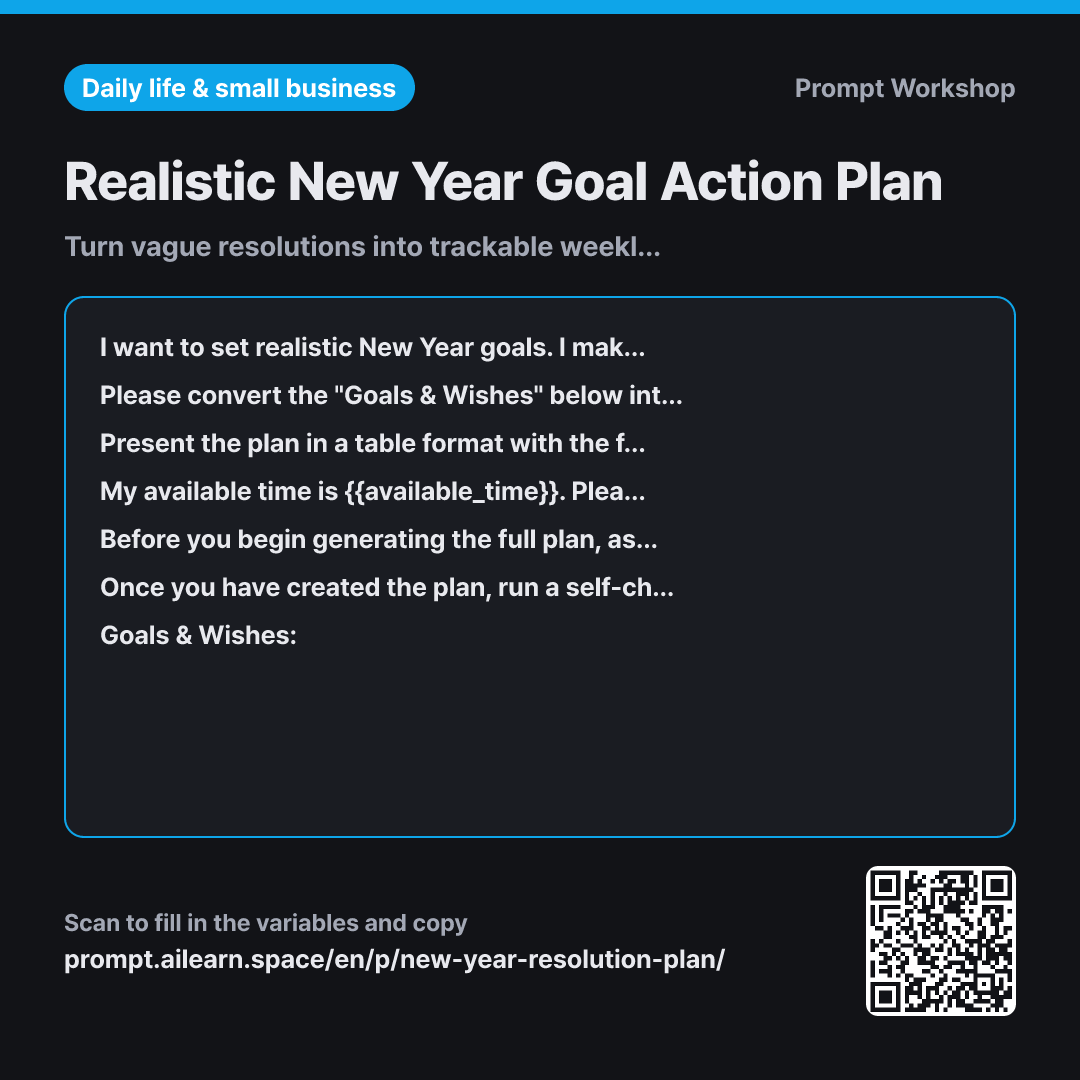
New Year resolutions often fail not due to a lack of willpower, but because of poor phrasing. Statements like "work out consistently" cannot be objectively verified as done or not done, leaving them vulnerable to drifting off. This prompt aims to transform vague resolutions into clear parameters: when, how often, and how to verify completion.
In the Task paragraph, limiting the goals to three items serves as the first filter. When people list their wishes, they typically name around six, which easily leads to burnout in week one. Asking for a one-line rationale for trimming ensures the user starts with clarity on why certain items were deprioritized.
In the Format paragraph, the crucial table columns are "Clear Completion Criteria" and "Recovery Action for Missed Weeks". The former establishes unambiguous verification criteria, while the latter prevents the user from abandoning the entire plan after a single bad week. The prompt also caps the time budget at 70% and restricts health goals to actionable behaviors rather than outcome metrics.
The fifth paragraph sets up Clarifying Questions. Because it is hard to list all routine constraints and deadlines upfront, limiting questions to three ensures necessary context without overwhelming the user. Finally, the Self-Verification step forces the AI to check its own output. Weekly time calculations frequently overflow in generated tables; prompting the model to re-audit its numbers catches most discrepancies immediately. Specifying three concrete review criteria also prevents generic, unhelpful praise.
Unfamiliar terms? See Aha AI: self-consistency, output-format
Compared with a bad example
Make a New Year plan for me. Workout, learning Spanish, reading, and saving money.
The AI simply takes all four items and builds a plan for every single one. Without instructions to prioritize, it tries to accommodate everything—resulting in "gym 3x/week, 30 min daily Spanish, 2 books a month, and $500 monthly savings." While it sounds plausible, it totals over 10 hours a week. Without knowing your available time, the AI creates an idealized schedule that collapses within the first month.
Variations
Reviewing an Existing Plan
Below is my current New Year plan. Please do not rewrite it yet; audit it first. Point out: ① Any vague phrases that lack clear completion criteria ② Items that are unrealistic given my {{available_time}} ③ Goals that lack a recovery step if missed. After identifying these, provide a revised version addressing only the single most critical bottleneck.
""" {{goals_and_wishes}} """
Asking for an immediate rewrite often turns your plan into a generic template. Reviewing first keeps ownership intact while refining only the highest-priority fix.
4-Week Trial Run
Select only one goal from the list below and create a 4-week trial plan. Keep it strictly under two sessions per week within my {{available_time}}, and define a one-line evaluation rule to decide whether to "continue or drop" it once the 4 weeks are over.
""" {{goals_and_wishes}} """
A full-year commitment feels daunting. Breaking it down into a 4-week sprint makes starting effortless, and if it doesn't work out, you can pivot to a different goal next month.
Model notes
LLMs can sometimes miscalculate the total weekly time in markdown tables. After receiving the output, verify by following up with: "Sum up the total weekly hours item by item and show the exact number."
Related prompts
Last updated 2026-09-02 · Found a mistake? Let us know