Why it is written this way
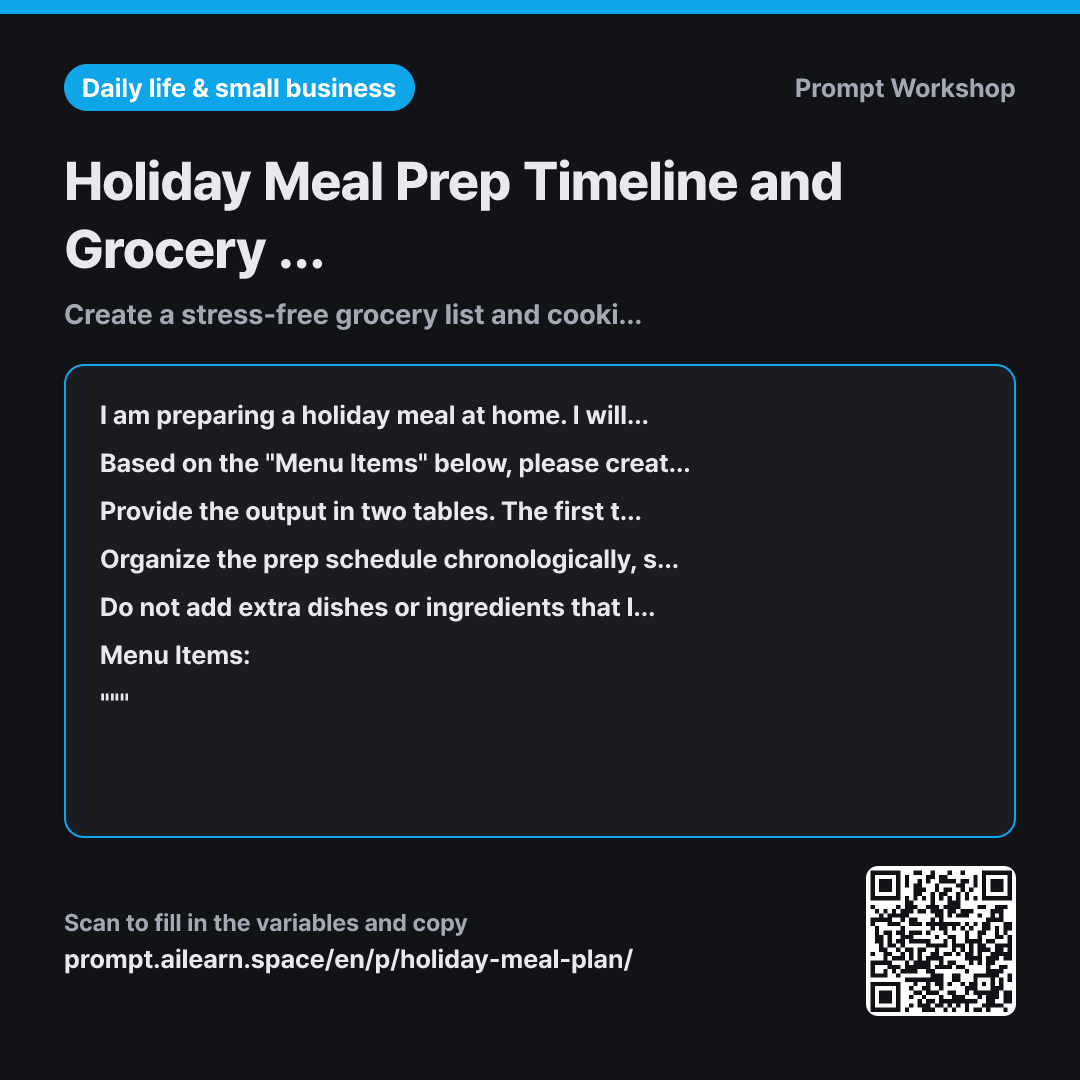
The hardest part of holiday cooking isn't the cooking itself—it's the bottleneck. If you just collect five recipes, you end up trying to make everything on the morning of the event, causing chaos in front of a limited stovetop. This prompt doesn't ask for recipes; it asks "what to do, when, and across how many days."
That is why the first paragraph includes context such as the number of stovetop burners and the lack of an oven. Without these constraints, an AI might blithely suggest roasting something in an oven or running three bubbling pots simultaneously. Breaking down the guest count into adults and children is also necessary for estimating portions. The task paragraph specifies two distinct outputs—grocery list and schedule—to keep the AI from defaulting into recipe explanations.
In the format section, the two tables serve different purposes. The grocery list is meant to be checked on a phone at the store, requiring "Purchase Date" and "Where to Buy," while the prep schedule is meant to be posted in the kitchen with specific time slots. If you only need a shopping checklist, you can use just the first table.
The fourth paragraph instructs the AI to break down the steps. A plan only becomes actionable when split into prep-ahead tasks, morning tasks, and just-before-serving steps. Restricting stovetop overlap reflects real kitchen bottlenecks. A simple sequential list collapses the moment burners are full, but allocating time slots lets you decide on the fly what to postpone.
The final paragraph enforces constraints against adding unprompted ingredients and prevents overconfident portion estimates. AI often tends to insert extra dishes suggesting "this would pair well," but adding an item to holiday prep expands both the grocery run and the schedule. Restricting storage advice to general guidelines serves the same purpose, as safe food storage depends heavily on individual kitchen conditions.
Unfamiliar terms? See Aha AI: output-format, prompt
Compared with a bad example
How do I prep for holiday dinner? I'm making turkey, mashed potatoes, green bean casserole, and pumpkin pie.
Because the prompt is completely open-ended, the AI will list out the recipe instructions for each dish one by one. You get ingredients and instructions, but no timeline of when to do what, forcing you to start all four dishes simultaneously on the day of the event. The ingredients will also be scattered across recipes, making you circle the grocery store aisles repeatedly.
Variations
When Guest Count Suddenly Increases
More guests are joining the meal I planned with {{menu items}}. The total count is now {{number of people}}. Without adding any new dishes, please regenerate the grocery list by scaling up the quantities of the existing menu. Additionally, categorize the dishes into those where scaling up adds almost no prep time versus those where prep time increases significantly and might be better to skip.
When guest counts rise, the instinct is to add more dishes, but prep time remains fixed. This variant locks the scope to scaling existing dishes rather than expanding the menu.
Staggering Prep Over Multiple Days
Instead of {{available prep time}}, I want to spread the preparation over three days, spending only 90 minutes each day. Please create a 3-day schedule for the dishes below. Push any items that lose quality when made ahead to the final day, and add a single-line summary at the end of each day stating: "Safe stopping point for today."
""" {{menu items}} """
Spreading prep over multiple days requires clear stopping checkpoints so you can cleanly pause and pick up the next day.
Related prompts
Last updated 2026-09-02 · Found a mistake? Let us know