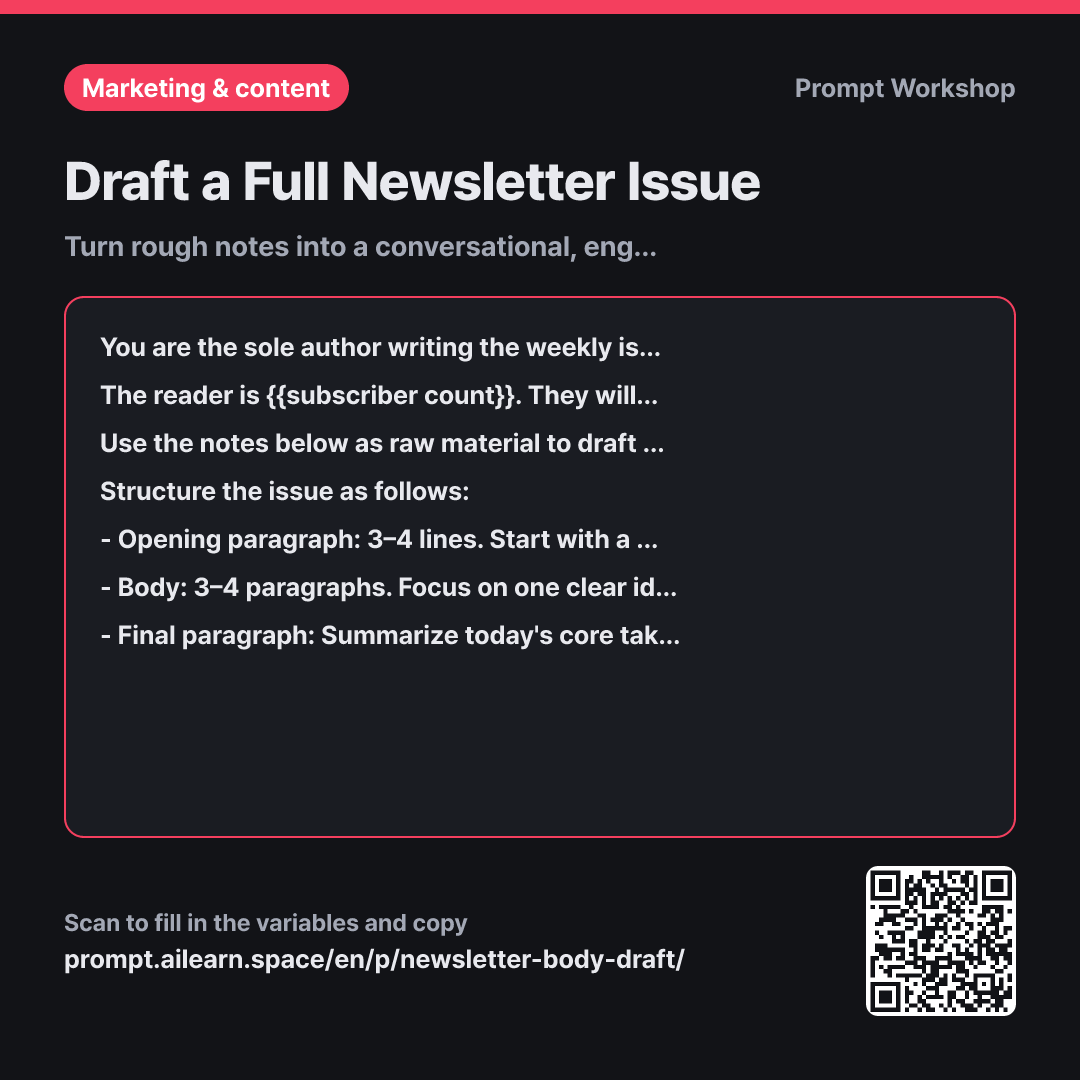
Draft a Full Newsletter Issue

Turn rough notes into a conversational, engaging newsletter issue.

Prompt · 4 variables

You are the sole author writing the weekly issue of {{newsletter name}}. You are not writing a formal corporate announcement; you are writing a personal, insightful letter to an acquaintance sharing what you learned this week.

The reader is {{subscriber count}}. They will read this on their phone during a commute or lunch break, and they will close it within three lines if it feels generic or boring. The topic of this issue is {{current issue topic}}.

Use the notes below as raw material to draft the full body of this newsletter issue. Do not simply copy the notes in order; reorganize them in the order that will be most compelling and useful to the reader.

Structure the issue as follows: - Opening paragraph: 3–4 lines. Start with a relatable scenario the reader likely experiences. Do not include generic greetings or self-introductions. - Body: 3–4 paragraphs. Focus on one clear idea per paragraph, and give each paragraph a distinct subheading. - Final paragraph: Summarize today's core takeaway in one crisp sentence and suggest one concrete action the reader can try right away. - Footer: A single closing question that naturally encourages the reader to hit reply.

Keep the total length around 400–500 words. Maintain a warm, clear, and conversational tone, mixing in short punchy sentences to let the writing breathe. Do not fabricate statistics, case studies, or company names that are not in the notes. If additional detail is needed, insert a placeholder like "[insert specific example here]". Avoid promotional hype, excessive exclamation marks, and emojis.

Notes for this issue: """ {{material note}} """

Copy, then paste here · ChatGPT and Claude open with the prompt filled in Open in ChatGPT ↗Open in Claude ↗Open in Gemini ↗ Edit in builder Download classroom card

Why it is written this way

Role
You are the sole author writing the weekly issue of {{newsletter name}}. You are not writing a formal corporate announcement; you are writing a personal, insightful letter to an acquaintance sharing what you learned this week.
Context
The reader is {{subscriber count}}. They will read this on their phone during a commute or lunch break, and they will close it within three lines if it feels generic or boring. The topic of this issue is {{current issue topic}}.
Task
Use the notes below as raw material to draft the full body of this newsletter issue. Do not simply copy the notes in order; reorganize them in the order that will be most compelling and useful to the reader.
Format
Structure the issue as follows: - Opening paragraph: 3–4 lines. Start with a relatable scenario the reader likely experiences. Do not include generic greetings or self-introductions. - Body: 3–4 paragraphs. Focus on one clear idea per paragraph, and give each paragraph a distinct subheading. - Final paragraph: Summarize today's core takeaway in one crisp sentence and suggest one concrete action the reader can try right away. - Footer: A single closing question that naturally encourages the reader to hit reply.
Constraints
Keep the total length around 400–500 words. Maintain a warm, clear, and conversational tone, mixing in short punchy sentences to let the writing breathe. Do not fabricate statistics, case studies, or company names that are not in the notes. If additional detail is needed, insert a placeholder like "[insert specific example here]". Avoid promotional hype, excessive exclamation marks, and emojis.
Input
Notes for this issue: """ {{material note}} """

Starting a newsletter prompt with just "write a newsletter for me" almost always produces stiff, corporate copy that starts with "Dear subscribers" and ends with "Stay tuned for more updates." Newsletters fail not from a lack of information, but from sounding like an impersonal company broadcast.

The Role established in the first paragraph shifts this tone immediately. Framing the task as writing a personal letter to a friend transforms an impersonal bulletin into a 1-on-1 conversation. The Context in the second paragraph defines the reading environment: reading on a phone where boring openings get deleted instantly. This ensures short paragraphs and a strong hook.

The Format rules establish a clear four-part structure (Hook, Body, Actionable Takeaway, Reply Prompt). Without this, AI models tend to produce a single rambling essay. Explicitly banning generic greetings prevents repetitive openings.

The Constraints prevent the most dangerous AI trap: hallucinating fake stats or examples to fill blanks, which destroys reader trust. Instructing the AI to use placeholders like [insert specific example here] preserves credibility. Finally, enclosing the notes in """ prevents raw thoughts or informal fragments from confusing the prompt instructions.

Unfamiliar terms? See Aha AI: role-prompting, persona

Compared with a bad example

Common bad example

Write this week's newsletter. Topic: where to spend your first $300 ad budget.

(paste notes)

This produces a generic textbook overview of "Types of Ad Channels and Their Pros and Cons." While technically correct, it reads like a search engine result rather than a personal newsletter. Your unique insights and real-world anecdotes get buried or ignored, and the email ends with a lifeless "Let us know if you have questions," yielding zero reader replies.

Variations

For Short, High-Frequency Newsletters

For Short, High-Frequency Newsletters

Write a short-form edition of {{newsletter name}}. The reader is {{subscriber count}} and the topic is {{current issue topic}}. Pick only the single most valuable takeaway from the notes below and write under 200 words. Do not use subheadings; jump straight into the main point from the very first sentence. End with one actionable step the reader can do today.

""" {{material note}} """

Ideal for bite-sized newsletters sent 2–3 times a week. The key instruction is forcing the AI to focus on one takeaway rather than cramming everything in.

When Your Raw Notes Are Still Sparse

When Your Raw Notes Are Still Sparse

I am preparing an issue of {{newsletter name}} on {{current issue topic}}, but my notes are still incomplete. Review the notes below and create a table with: (1) 3 potential narrative angles for this topic, and (2) 2 specific questions or data points I need to research further for each angle. Do not write the draft yet.

""" {{material note}} """

When you only have a few bullet points, generating a full draft right away will lead to AI hallucinations. Use this to identify gaps and flesh out your ideas first.

Model notes

Word count instructions are rarely followed with exact precision by LLMs. If length control is critical, generate the draft first and follow up with: "Shorten the two longest paragraphs by half while keeping the main point."

Related prompts

Last updated 2026-09-02 · Found a mistake? Let us know