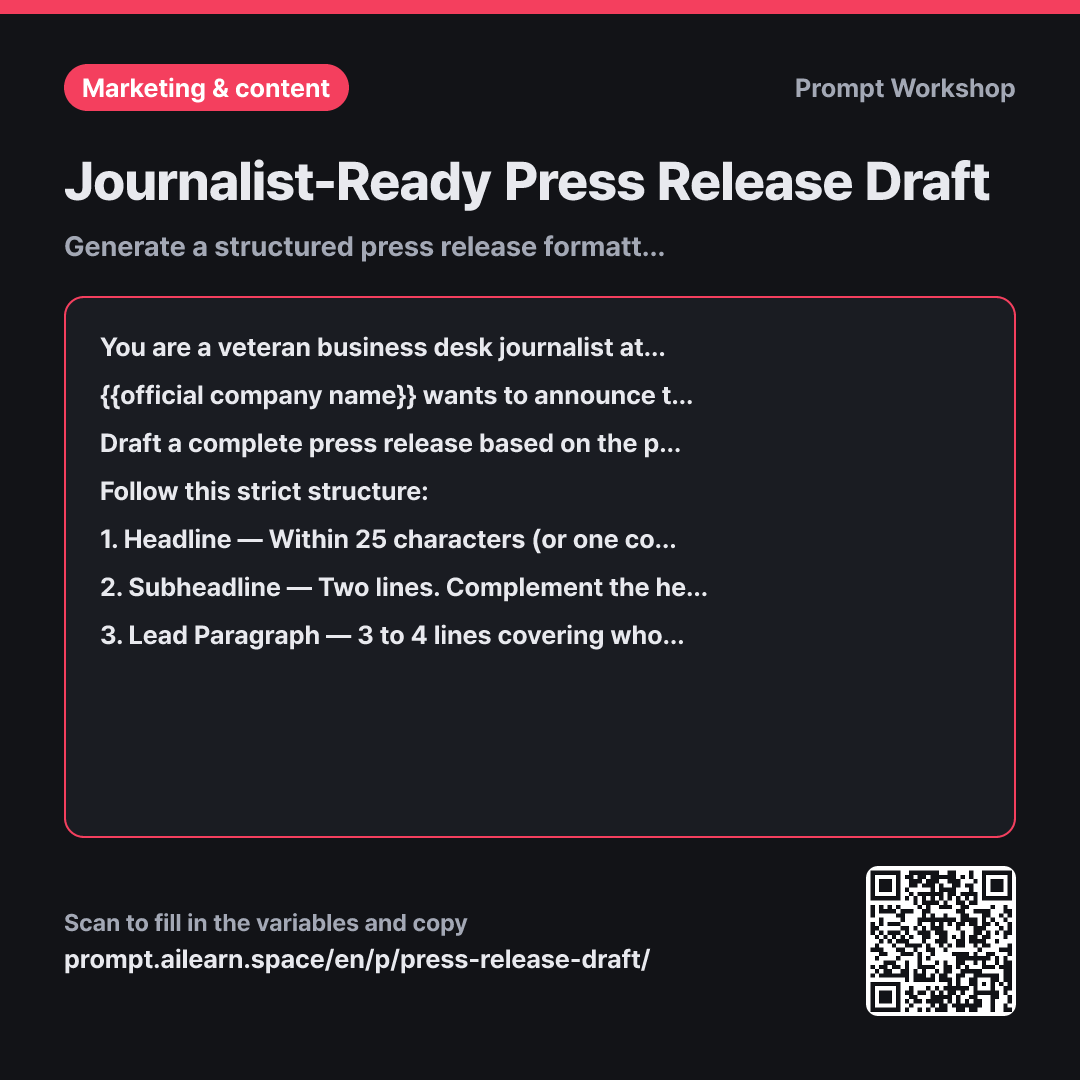
Journalist-Ready Press Release Draft

Generate a structured press release formatted for immediate media pickup.

Prompt · 4 variables

You are a veteran business desk journalist at a major news outlet. You receive dozens of press releases daily, skim each for 20 seconds to decide if it's newsworthy, and publish selected stories after editing only the first few lines.

{{official company name}} wants to announce the information below. The reader is a busy journalist, not an internal marketing team. The journalist cares about what changed, when it changed, and who it affects—not vague company aspirations or corporate fluff.

Draft a complete press release based on the provided facts. Use the inverted pyramid structure: place the most crucial facts at the very top and progressively less critical details toward the bottom, ensuring the story remains complete even if trimmed from the end.

Follow this strict structure: 1. Headline — Within 25 characters (or one concise line). Clearly state what happened using an active verb. 2. Subheadline — Two lines. Complement the headline with key figures or conditions. 3. Lead Paragraph — 3 to 4 lines covering who, what, when, where, and why. 4. Body Paragraphs — 3 to 4 short paragraphs. Dedicate each paragraph to a single distinct fact. 5. Executive Quote — 2 to 3 sentences attributed to {{quote speaker source}}. Focus on the underlying reason for this launch rather than generic excitement or vague ambitions. 6. Boilerplate (About the Company) — Max 3 lines. If no background information is provided, write "[Company boilerplate required]" without making anything up. 7. Media Contact — {{contact person info}}.

Do not fabricate unprovided numbers, dates, awards, or customer names. If there are likely questions a journalist would ask that cannot be answered from the text, list up to 5 bullet points under a "Questions a Reporter Might Ask" section at the very bottom instead of putting assumptions in the body. Avoid buzzwords like "innovative," "revolutionary," or "industry-first," and do not use exclamation marks. State objective facts only.

Announcement details: """ {{presentation content}} """

Copy, then paste here · ChatGPT and Claude open with the prompt filled in Open in ChatGPT ↗Open in Claude ↗Open in Gemini ↗ Edit in builder Download classroom card

Some variables here may contain personal data. Replace real names, numbers and company names with placeholders.

Why it is written this way

Role
You are a veteran business desk journalist at a major news outlet. You receive dozens of press releases daily, skim each for 20 seconds to decide if it's newsworthy, and publish selected stories after editing only the first few lines.
Context
{{official company name}} wants to announce the information below. The reader is a busy journalist, not an internal marketing team. The journalist cares about what changed, when it changed, and who it affects—not vague company aspirations or corporate fluff.
Task
Draft a complete press release based on the provided facts. Use the inverted pyramid structure: place the most crucial facts at the very top and progressively less critical details toward the bottom, ensuring the story remains complete even if trimmed from the end.
Format
Follow this strict structure: 1. Headline — Within 25 characters (or one concise line). Clearly state what happened using an active verb. 2. Subheadline — Two lines. Complement the headline with key figures or conditions. 3. Lead Paragraph — 3 to 4 lines covering who, what, when, where, and why. 4. Body Paragraphs — 3 to 4 short paragraphs. Dedicate each paragraph to a single distinct fact. 5. Executive Quote — 2 to 3 sentences attributed to {{quote speaker source}}. Focus on the underlying reason for this launch rather than generic excitement or vague ambitions. 6. Boilerplate (About the Company) — Max 3 lines. If no background information is provided, write "[Company boilerplate required]" without making anything up. 7. Media Contact — {{contact person info}}.
Constraints
Do not fabricate unprovided numbers, dates, awards, or customer names. If there are likely questions a journalist would ask that cannot be answered from the text, list up to 5 bullet points under a "Questions a Reporter Might Ask" section at the very bottom instead of putting assumptions in the body. Avoid buzzwords like "innovative," "revolutionary," or "industry-first," and do not use exclamation marks. State objective facts only.
Input
Announcement details: """ {{presentation content}} """

Asking an AI to write a press release without specific instructions produces hollow marketing fluff. Releases that open with "We are thrilled to lead the market with innovative solutions" get deleted within seconds. A press release is not a self-congratulatory brochure; it is a semi-finished editorial product meant for reporters to reuse immediately.

This is why the Role is set to a seasoned journalist. Asking for a PR manager's voice creates internal corporate spin, whereas a journalist's perspective retains only hard news. The Context in the second paragraph reinforces that editors skim in 20 seconds, looking for tangible changes rather than executive optimism.

Instructing the AI that "the story must remain functional even if trimmed from the bottom" enforces the classic journalism inverted pyramid, preventing the common flaw of burying the lead behind lengthy background context.

The Format section locks down a seven-part layout. Restricting the quote to "reasons rather than generic excitement" prevents empty corporate statements. The Constraint section blocks hallucinated metrics and redirects missing information to a practical Q&A appendix. Enclosing the raw notes in """ keeps stray input directives from hijacking the prompt.

Unfamiliar terms? See Aha AI: role-prompting, output-format

Compared with a bad example

Common bad example

Write a press release announcing our new app launch.

(pasting raw notes)

This produces promotional copy filled with phrases like "We aim to realize customer satisfaction through this innovative launch." Crucial details like pricing and release dates end up scattered in lower paragraphs, forcing reporters to rewrite the entire text. Compelling metrics such as beta user counts get lost, and boilerplate or media contacts are missing entirely.

Variations

Brief News Brief / Media Alert

Brief News Brief / Media Alert

Turn the announcement below from {{official company name}} into a concise news brief. Include a single-line headline, one 4–5 line body paragraph, and the media contact ({{contact person info}}). Do not include quotes or a company boilerplate. Use only the dates and numbers explicitly provided in the notes, without fabricating details.

""" {{presentation content}} """

Best for minor product updates, event alerts, or routine notices that do not warrant a full-length release. Pre-condensing the story saves the journalist editing time.

Spokesperson Quote Variations

Spokesperson Quote Variations

Generate 3 alternative quote drafts attributed to {{quote speaker source}} based on the announcement details below. Each quote must be under two sentences. Focus one on the problem being solved, one on the immediate benefit to users, and one on future roadmap plans. Avoid clichés like "we will do our best" or "leading the market," and ground every statement in the provided facts.

""" {{presentation content}} """

Executive quotes are the most frequently revised part of any release. Generating three clear angles lets the spokesperson choose and approve the final text in one round.

Model notes

Drafted quotes are AI-generated suggestions, not actual transcribed statements. Always verify and receive explicit sign-off from the named speaker before distribution, and manually confirm that the media contact details are accurate.

Drafted quotes are AI-generated suggestions, not actual transcribed statements. Always verify and receive explicit sign-off from the named speaker before distribution, and manually confirm that the media contact details are accurate.

Related prompts

Last updated 2026-09-02 · Found a mistake? Let us know